
PREDICTIVE ANALYSIS IN FINANCE: HARNESSING AI FOR MARKET FORCASTING


1 Dr. Hamid Mohsin Jadah; 2*Sakina Fatima
1 Associate Professor at the Department of Finance and Banking, College of Administration and Economics, University of Karbala, Iraq. hamed.m@uokerbala.edu.iq
2*Department of Computer Science & Engineering; All Saints' College of Technology, Bhopal, Madhya Pradesh, India.
Corresponding Author: Sakina Fatima Email: sakina.fatima.imam@gmail.com
Orcid: Dr. Hamid: - https://orcid.org/0000-0002-8170-5453
ABSTRACT
Predictive analysis has become vigorous tool in finance, significantly enhancing market forecasting & helping stakeholders make more precise, data-driven decisions. With rise of AI, predominantly in fields of ML & data science, financial institutions can now analyze large volumes of historical & real-time data to predict market trends, stock prices, & economic patterns. This paper explores influence of AI on finance, focusing on techniques, use cases, & trials elaborated in applying predictive analysis to forecast financial markets. It provides concise overview of AI's transformative role in finance, with predictive analysis emerging as revolutionary approach to market forecasting.
Keywords: Predictive analysis, AI in finance, machine learning, market forecasting, fiscal markets, stock prediction.
INTRODUCTION
Fiscal markets are characterized by their unpredictable & fluctuating nature, often driven by variety of interconnected factors. These include macroeconomic indicators like inflation rates, interest rates, & GDP growth, which directly impact investor confidence & overall market performance. Furthermore, geopolitical events ranging from elections & policy changes to conflicts & trade disputes can lead to market instability, triggering rapid shifts in asset values. Lastly, investor sentiment , or collective emotions & reactions of market participants, can play significant role in driving market trends, as fear & optimism influence buying & selling behavior. Traditionally, market forecasting relied heavily on historical data & statistical like time series analysis, regression models, & econometric methods. These models,
while useful, were often limited in their ability to account for rapidly changing & multi- dimensional nature of modern fiscal markets. As a result, predictions were sometimes less accurate, especially in periods of extreme volatility or when rare, unforeseen events (like fiscal crises) occurred. With explosion of big data , fiscal analysts now have access to vast & varied sources of information ranging from real-time market data, fiscal statements, & economic reports to unconventional data sources like social media feeds, satellite imagery, & even sentiment analysis of news articles. This sheer volume & variety of data present opportunities to improve market forecasts, but they also pose significant challenges in terms of data processing & interpretation.
Advent of AI & its subset, machine learning (ML), has transformed this landscape by enabling models that can not only process large datasets efficiently but also recognize complex, non- linear relationships that traditional models may overlook. ML models, like neural networks, & deep learning algorithms, can sift through enormous amounts of structured & unstructured data, identifying patterns & correlations that humans or conventional methods might miss. For instance, sentiment analysis powered by Natural Language Processing (NLP) can track investor sentiment by analyzing millions of social media posts, news articles, & fiscal reports, offering real-time insights into market mood & potential price movements. Similarly, AI-driven predictive models can analyze historical data in combination with real-time factors (e.g., trading volumes, economic indicators) to make dynamic predictions on stock prices, volatility, or asset performance. Integration of AI & big data into market forecasting has greatly enhanced ability of fiscal institutions to make more accurate, data-driven predictions. These advanced models not only recover precision of forecasts but also offer real-time adaptability, allowing for quicker responses to emerging trends & sudden market shifts. However, challenges like data quality, model overfitting, & ethical implications of AI-driven decision- making remain critical considerations in fully harnessing power of predictive analysis in finance.
METHODS OF PREDICTIVE ANALYSIS IN FINANCE
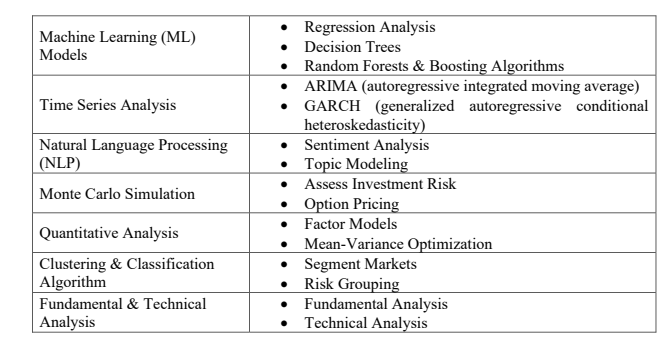
Methods of Predictive Analysis in Finance involve various advanced techniques & tools used to forecast market trends, stock prices, risks, & economic outcomes. These methods leverage historical & real-time data to generate insights that help fiscal institutions make more informed decisions. Predictive analysis methods in finance leverage combination of historical data, real- time information, & advanced algorithms to forecast market trends, assess risks, & improve decision-making. As AI & ML technologies advance, these methods will continue to evolve, providing even more accurate & actionable financial predictions. AI-driven predictive analysis employs several techniques, including:
-
Machine Learning (ML): ML models, such as regression analysis, decision trees, and deep learning, can analyze historical market data to predict future price movements. These models continuously learn and adapt based on new data, improving their accuracy over time.
-
Natural Language Processing (NLP): NLP helps analyze text-based data such as news articles, social media, and financial reports. Sentiment analysis using NLP can gauge market sentiment and forecast stock market volatility.
-
Time Series Analysis: This method predicts future values based on past data patterns, particularly useful for forecasting stock prices, trading volumes, and interest rates.
Table 1: Key methods of predictive analysis in finance:
APPLICATIONS IN FINANCE
Predictive analysis finds application in several areas of finance, including:
-
Stock Market Prediction: AI models can analyze historical stock prices, trading volumes, and market sentiment to predict future stock prices. Hedge funds and investment firms use such models to develop trading strategies.
-
Credit Risk Assessment: Financial institutions use predictive analysis to assess the risk profile of borrowers. AI can evaluate vast amounts of customer data to predict defaults or late payments.
-
Fraud Detection: Predictive models can identify unusual transaction patterns, helping detect fraudulent activities before they occur.
Challenges:
While AI-driven predictive analysis offers significant potential, several challenges remain:
-
Data Quality: Predictive models are only as good as the data they analyze. Poor-quality data can lead to inaccurate forecasts.
-
Overfitting: Machine learning models may sometimes perform well on training data but fail to generalize to new, unseen data, leading to unreliable predictions.
-
Ethical and Regulatory Concerns: The use of AI in finance raises questions around transparency, fairness, and accountability. Regulators are increasingly scrutinizing AI- driven decision-making to ensure compliance with financial laws.
CONCLUSION
AI-powered predictive analysis has revolutionized financial market forecasting, providing more accurate, data-driven insights. As AI models continue to evolve, their precision and utility
in predicting financial outcomes will only increase. However, addressing challenges such as data quality, model reliability, and ethical issues will be essential to fully unlocking the potential of AI in the finance sector.
REFERENCES
-
Goel, Manjusha & Tomar, Parveen & Vinjamuri, Priya & Reddy, G. & Al-Taee, Mustafa & Alazzam, Malik. (2023). Using AI for Predictive Analytics in Financial Management. 963-967. 10.1109/ICACITE57410.2023.10182711.
-
Hussain, Khalid. (2023). Harnessing AI for Predictive Accuracy in Financial Forecasting and Risk Assessment. 10.13140/RG.2.2.17070.73281.
-
Chopra R, Sharma GD. Application of Artificial Intelligence in Stock Market Forecasting: A Critique, Review, and Research Agenda. Journal of Risk and Financial Management . 2021; 14(11):526. https://doi.org/10.3390/jrfm14110526
-
El Hajj M, Hammoud J. Unveiling the Influence of Artificial Intelligence and Machine Learning on Financial Markets: A Comprehensive Analysis of AI Applications in Trading, Risk Management, and Financial Operations. Journal of Risk and Financial Management . 2023; 16(10):434. https://doi.org/10.3390/jrfm16100434
-
Yelne S, Chaudhary M, Dod K, Sayyad A, Sharma R. Harnessing the Power of AI: A Comprehensive Review of Its Impact and Challenges in Nursing Science and Healthcare. Cureus. 2023 Nov 22;15(11): e49252. doi: 10.7759/cureus.49252. PMID: 38143615; PMCID: PMC10744168.
-
González-Núñez E, Trejo LA, Kampouridis M. A Comparative Study for Stock Market Forecast Based on a New Machine Learning Model. Big Data and Cognitive Computing . 2024; 8(4):34. https://doi.org/10.3390/bdcc8040034