
ENVIRONMENTAL LIABILITIES IN CORPORATE INSOLVENCY: RETHINKING THE IBC WATERFALL MECHANISM
Author : Gayatri Kammela1*
Corresponding Author
Gayatri Kammela
Email : bsl223035@nujs.eduABSTRACT
The interrelation between corporate insolvency and environmental law poses a significant regulatory challenge for the Insolvency and Bankruptcy Code, 2016 (IBC) in India. The IBC prioritises the efficient resolution of distressed companies and maximises creditor recovery; however, it does not explicitly address environmental liabilities, including clean-up/remediation obligations and ecological damage caused by pollution.
This article examines the structural conflict between insolvency and environmental accountability in the context of the IBC, particularly with respect to the distribution hierarchy set out under Section 53 of the IBC (the “waterfall mechanism”). Environmental claims are not treated as a separate category of claim in the distribution hierarchy under the waterfall mechanism, meaning they are either operational debts or government debts, both of which have low priority. Because of this, environmental remediation costs are generally left unpaid after secured creditors have been paid, enabling corporate polluters to externalise the costs of their environmental pollution through corporate insolvency proceedings. This outcome erodes the “polluter pays” principle that has been developed in Indian environmental jurisprudence.
Using doctrinal analysis and comparative experience from other jurisdictions, this article argues that targeted reforms to the IBC are needed to align the efficiency of the insolvency system with that of the environmental protection system. The article suggests that environmental liabilities should be recognised as statutory liabilities under the IBC, that remediation costs should be given limited priority in the distribution arrangement of the liquidation waterfall, and that environmental remediation funds be created to address residual clean-up obligations. Such reforms would help ensure that corporate insolvency does not operate as a mechanism to escape environmental liability.
Keywords: Environmental Liabilities, Waterfall Mechanism, Section 53, Polluter Pays Principle, Creditor Priority, Corporate Insolvency.
INTRODUCTION
The enactment of the Insolvency and Bankruptcy Code, 2016 (“IBC”), represents a significant step in reshaping India's bankruptcy regime, providing a defined time for resolving corporate insolvency and ensuring the maximum realization of asset value by changing the overall process to a creditor-in-control structure. In addition, the Code seeks to restore a viable business by providing a "clean slate" to resolution applicants and to create a mechanism for resolving liabilities incurred as a result of prior actions. With the enactment of the IBC and, hence, the complex overlap between environmental law and insolvency law, the difficulties multiplied. The development of Indian environmental law has been guided by the ‘polluter pays' principle. Those responsible for pollution and/or environmental degradation are made to pay for the costs and damages incurred by this harm.
This dilemma centers on the waterfall mechanism in Section 53 of the IBC, which establishes the hierarchy of asset distribution during liquidation. Section 53 lists insolvency resolution costs, secured creditors, and workmen's dues as having priority, whereas government dues and all other unsecured claims fall behind. This is problematic because environmental responsibilities, including remediation costs, regulatory penalty costs, and ecological harm compensation, are not explicitly mentioned in the statute; therefore, they must be classified under one of the other categories, usually operational debts or statutory obligations, both of which fall lower on the priority list.
As a result, after secured creditors recover their claims, there may be little or no assets available to pay for the costs of environmental restoration. This means that companies can destroy entire ecosystems, declare insolvency, and emerge without any environmental responsibilities, leaving behind contaminated “brownfield” sites that require state and taxpayer-funded remediation.
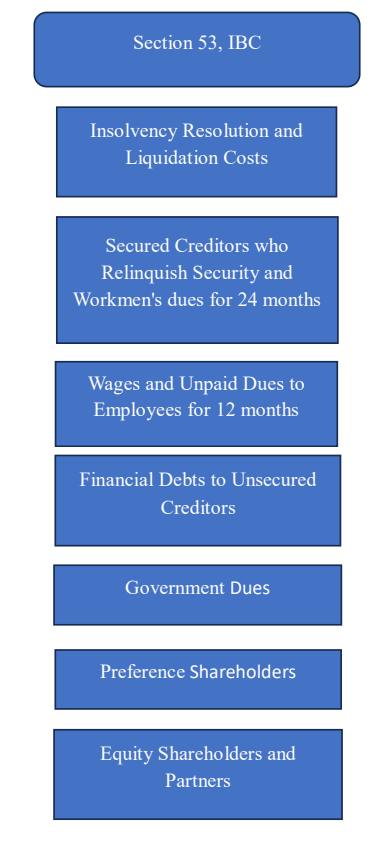
The liquidation framework under the Insolvency and Bankruptcy Code, 2016 (IBC), includes a statutory order of priority for payments made from the corporate debtor. This priority list, often referred to as the "waterfall mechanism," is codified in Section 53 of the IBC.
Under Section 53, insolvency resolution and liquidation costs receive priority, followed by secured creditors who relinquish security and workmen’s dues for the preceding 24 months. The Supreme Court in Committee of Creditors of Essar Steel India Ltd v. Satish Kumar Gupta held that the distribution framework under the IBC reflects the legislature’s intention to priorities secured creditors and to respect the commercial wisdom of the Committee of Creditors in determining the allocation of assets.
The third tier in the waterfall comprises any unpaid wages and any other amounts owed to employees, other than workmen, for the 12 months before the date of commencement of liquidation. The fourth-tier deals with unsecured financial creditors; i.e., they will be paid only after the secured creditors and employees have been paid. The fifth tier of the waterfall comprises all amounts owed to the Central or State governments within the 2 years preceding the liquidation, and any remaining amounts due to secured creditors who exercised their security rights outside the liquidation process. The placement of government dues in the fifth tier reflects the IBC’s intent to subordinate state claims to those of private creditors, thereby promoting lending and investment.
Next, the sixth tier consists of any other amounts due, including residual claims not listed under the previous tiers of the hierarchy. The upper tiers of the waterfall consist of preferred shareholders, with the last tier being equity shareholders/partners, who have the lowest priority due to their residual ownership interest in the business.
However, it also raises significant liabilities related to environmental obligations. Section 53 does not specifically list environmental remediation, penalties for environmental violations, or compensation for environmental damages as its own tier in the waterfall.
Can environmental liabilities be considered as ‘claims’ under the IBC?
Where do Environmental Liabilities Fit?
The mismatch between environmental and insolvency law is primarily due to the failure to create a clear The mismatch between environmental and insolvency law is primarily due to the failure to create a clear statutory class for the treatment of these liabilities in the IBC, as well as the lack of provision for specific costs associated with environmental remediation, the payment of regulatory fines/penalties and compensation to those impacted by damage to their environment. Therefore, there are no clear statutory provisions in the Insolvency Code for allocating this type of liability, leading to confusion about the treatment and enforcement of these claims when an environmental polluter goes into bankruptcy.
Characterizing Environmental Liabilities as Governmental Dues
One possible way of categorizing environmental liabilities is as government dues. Environmental liabilities exist because, under most state law, they are considered obligations owed to the state and thus treated as "state dues". When a regulator such as the Central Pollution Control Board or a State Pollution Control Board imposes a penalty or orders remediation for contamination caused by a company, it does so within its statutory authority and on behalf of the Government of India. Thus, we can argue that regulatory authorities should therefore consider penalties and compensation as state claims.
However, the IBC ranks government dues below secured creditors, governmental authority dues, unsecured financial creditors, workmen's dues, and employee salaries. This means that when a corporate debtor goes into liquidation, all available assets will have been exhausted by claims ranking higher than all of the above-mentioned governmental claims, leaving virtually all government claims unpaid.
To the extent that environmental liabilities are classified as government dues, regulators' regulatory efforts are undermined. The liability may be established, and the regulators may be able to impose a penalty, only to have the insolvency process eliminate that liability by placing the penalty at the bottom of the list of obligations to be repaid. This leads to a practical loss of accountability for the environment.
Characterizing Environmental Liabilities as Operational Debt
As defined in IBC section 5(21), ‘operational debt’ is any money due to a creditor for the supply of goods or services to the debtor. A creditor with such a claim is an operational creditor for section 5(20).
If, in a case, a statutory environmental regulator claims, by statute, that it has a reason to collect a penalty from the regulated person for breach of environmental law, the case could be made that the penalty meets that debt definition. The actual fit isn't perfect. Environmental liabilities typically arise from regulatory action to ensure compliance with statutory obligations rather than from commercial agreements. Unlike Traditional operational debt, where creditors provide goods or services, environmental liabilities represent damage done to the public’s air, water, and land.
In effect, this creates a mismatch between two distinct sets of doctrine. Recognizing environmental regulators as operational creditors could reduce environmental enforcement to a status similar to ordinary (commercial) debt. Additionally, operational creditors are granted far less authority in the insolvency process than their counterparts in the commercial world. An operational creditor has limited voting rights in the Committee of Creditors (“CoC”) during the Corporate Insolvency Resolution Process (“CIRP”). As a result of this situation, the potential impact of environmental claims that have been construed as operational debts may not be fully realized during the insolvency process.
Characterizing Environmental Liabilities as Tort or Statutory Liability
Another way of characterizing environmental liabilities is as obligations to fulfil statutory and/or common law duties of care resulting from harm caused to the environment. Environmental damage typically results in harm to public resources and ecosystems, not in damages arising from the breach of private contracts. Therefore, the statutory schemes that hold polluters liable for their actions, and the developing body of case law that provides for accountability for environmental harm, are created by legislation or common law.
The Indian judiciary has made substantial use of the doctrines and principles related to the polluter-pays principle and the absolute liability doctrine. These two doctrines were established by the Supreme Court of India in landmark cases, including M.C. Mehta v. Union of India and Indian Council for Enviro-Legal Action v. Union of India. In these decisions, the Court ruled that all enterprises that engage in hazardous or environmentally harmful activities must pay for all environmental damage and the costs to affected communities.
The thinking behind these doctrines is that environmental liabilities are not “normal” financial exposures but obligations imposed on a person (or persons) through public law to remediate the environment and protect the public from the costs of polluter-created environmental harm. However, under current insolvency law, there is no distinction between these obligations and others, such as bankruptcy-related unsecured creditors; as a result, the important normative commitment to the “polluter pays” principle inherent to environmental law will be dulled in the insolvency context.
Comparative Perspective
There is no well-developed conceptual edifice in Indian law on how to address environmental liabilities under the IBC, and a comparative study shows that the conflict between bankruptcy law and environmental law is one that other jurisdictions have faced.
In the US the courts were faced with the question of whether these obligations to remediate environmental contamination were dischargeable debts in the bankruptcy context, of which Ohio v Kovacs is a leading case, in which the Supreme Court faced the issue of whether the debtor’s obligation to clean up the contamination was a dischargeable claim because obligation had in effect morphed into a demand for money and that the debtor could not clean up the hazard. At the same time, that decision answered some questions concerning the treatment of environmental liability in bankruptcy. It also raised concerns that environmental polluters could circumvent their cleanup requirements through bankruptcy. After that decision, the US courts have attempted to allay those fears and to declare that there is a distinction between financial claims and regulatory obligations: environmental injunctions demanding that a debtor comply with environmental law are not necessarily destroyed by bankruptcy treats that orderly arrangements could not be made for an effective regulatory scheme and the regulatory authority can exercise its police powers and enforce the regulatory scheme for environmental regulation, even though the bankruptcy process.
The objective of the US bankruptcy law is to achieve a given degree of financial rehabilitation of the debtor and to provide for an equitable recovery by the creditor. The function of regulation is to protect and promote society’s interests in preserving ecosystems and public health. Our current insolvency regime in India lacks a clear doctrinal framework for addressing environmental liabilities, and the absence of specific provisions in the IBC results in environmental obligations being treated as nothing more than ordinary financial claims, thereby diluting the level of environmental accountability achieved in its application.
THE LEGAL GAP
This void in the IBC's recognition of environmental obligations creates a major regulatory coverage gap. It might well be that this obligation is relegated to existing categories, such as government dues or operational debt, both of which have minimal standing in the insolvency proceedings pecking order. Such that in most cases, even if a court were to find a party liable for environmental harm, there would be insufficient funds available in insolvency to make good for or remediate the harm done to the environment. The Supreme Court judgement in Ghanshyam Mishra & Sons Pvt Ltd. v. Edelweiss Asset Reconstruction Company only compounds this problem, since the Court held that once a resolution plan has been accepted, all claims not included in that plan shall stand extinguished, and the successful resolution applicant shall not incur any liability to those claims. This promotes certainty and creates an incentive for resolution applicants to rehabilitate distressed companies, but also puts in jeopardy the regulatory environmental claims for remediation, since they would be extinguished if not acknowledged in the process.
Essentially, the joint goals of insolvency law and environmental law are at odds: insolvency law seeks to promote recovery for creditors by maximizing efficiency, whilst environmental law seeks to hold all parties accountable for environmental degradation and to pursue remedial action to restore the environment for the benefit of the community. The big question is how to design a protocol to reconcile those priorities without introducing a mechanism that undermines environmental accountability.
Should Environmental Liabilities be Prioritized?
The provisions of the IBC raise other major normative questions about the priority accorded to environmental liabilities under Indian insolvency law. As discussed earlier, section 53 does not see claims for environmental damages made out. Still, it requires them to fall into some other category of debt, such as operational or government dues, which rank behind those of secured creditors. That claims in respect of environmental damage cannot get priority under this procedure means we are failing to act in support of our principles of environmental protection and promoting irresponsibility for environmental harm, and calls for a re-evaluation of the priority of environmental liabilities in insolvency.
One reason environmental liabilities should be given priority over other forms of debt is the irreversibility of environmental harm. With normal commercial debt, if you cleared it with money, it was paid. Pollution and other environmental violence, however small, would have damaged the natural ecosystem, the community, and public health forever, without the possibility of restoring Nature, Society, and Health once pollution does its monstrous work. When the river and air are “poisoned”, pollution does irreparable damage to the area and all life in it, and maybe all life dependent upon this, and any obligation capable of being fashioned about ‘pollution-caused’ damage, therefore, is not money but a requirement to restore.
The Supreme Court developed these principles in landmark environmental cases, which established the doctrine of absolute liability for hazardous industries and that polluters must bear the full cost of environmental remediation. However, if environmental claims are at the bottom of the insolvency waterfall, businesses that cause environmental harm will often be able to use an insolvency proceeding to completely escape liability for any environmental damage they have caused.
By ensuring that environmental liabilities rank equally with other business obligations in insolvency proceedings, the risk of moral hazard or "regulatory evasion" by businesses is significantly reduced. If companies know that their environmental liabilities will most likely be paid off and that they do not face serious economic consequences for failing to comply with environmental laws, they are likely to underinvest in compliance and allow their companies to fail. As a result, some of these companies may even engage in high-risk, environmentally damaging activities under the belief that they can always file for bankruptcy and avoid being held responsible for the consequences of their actions.
Such incentives will weaken the overall structure of the regulatory framework designed to protect the environment. Many federal and state environmental laws require companies to comply with stringent environmental regulations; those laws, including the Environment Protection Act and the Water Prevention and Control of Pollution Act they are specifically intended to deter businesses that do not comply with environmental laws. If businesses can circumvent their legal responsibilities through bankruptcy, the law becomes ineffective at deterring them from harming the environment. Prioritizing environmental liabilities within the insolvency framework will also allow the corporate decision-maker to become fully aware of the true cost of the harm caused by their actions. They will help to encourage greater compliance with environmental laws.
SUGGESTED REFORMS
The prevailing framework of corporate insolvency legislation contains a stark divide between its objectives and the rules governing environmental stewardship. The IBC's main goal is to allow for expeditious collocation and maximize returns for creditors. In contrast, the regulatory regime governing environmental law requires polluters to compensate the public for all environmental damage they cause.
Statutory Recognition of Environmental Claims
A major deficiency in current legislation is the lack of statutory entrenchment of environmental matters within the IBC. Currently, environmental claims are captured in broad existing categories, such as operational debt or government dues, neither of which reflects the public law character of the environmental obligation. An amendment to Section 53 would establish a separate category for ecological restoration expenses and environmental remediation costs. With explicit recognition, regulators, resolution professionals, and creditors will no longer operate under imprecise definitions. As a result, these environmental claims will not be treated as ordinary commercial claims against an insolvent company.
Super-Priority Status to Environment Remediation Costs
An even more progressive change would provide a limited ‘super-priority’ status for environmental remediation costs in the distributions set out in Section 53 . The super-priority status would allow for these costs to be placed either alongside or immediately following the costs associated with the insolvency resolution process in the distribution hierarchy. Environmental cleanup obligations differ essentially from ordinary financial liabilities because their primary purpose is to restore terrestrial ecosystems and protect public health. Super-priority recognition would therefore reserve sufficient funds for environmental cleanup before distributing the remaining assets to creditors. Furthermore, establishing a super-priority status would enhance the deterrent effect of regulatory enforcement of environmental statutes by preventing corporations from using the bankruptcy process to escape fiscal liability for the environmental impacts of their operations.
Establishment of Environment Remediation Funds
Policymakers may also want to consider establishing environmental remediation funds to cover cases where an insolvent business lacks sufficient assets to pay for its cleanup obligations. Environmental remediation funds could be funded through a variety of means, including fees charged to environmentally sensitive industries, regulatory fees assessed under the full-cost recovery model, or environmental insurance. If/when an environmentally irresponsible corporation goes into bankruptcy, and cleanup costs exceed recoveries through the bankruptcy process, these funds could be used to support restoration activities and reimburse affected communities. Supporting the environmental restoration funds in this manner would ensure that clean-up processes are not delayed or abandoned due to the financial failure of those affected.
As a whole, these proposed regulatory changes would help to ensure that the interests of corporate insolvency efficiency and environmental stewardship are no longer in conflict. We must recognise environmental responsibilities and establish statutory, super-priority rights for remediation costs, so corporations cannot exploit corporate rules to avoid their environmental sins.
CONCLUSION
The interplay between environmental and insolvency legislation reveals a noteworthy regulatory gap in the IBC. Environmental liabilities, whether arising from the cleanup of contaminated property, ecological restoration, or compensation to persons affected by environmental damage, are included in several categories of debt in the order of their priority, as per Section 53. Those categories include unsecured operational debts and unsecured government debts. Both types of debts rank at the lowest priority in the statutory waterfall; therefore, once the secured creditors and other preferred creditors' claims are satisfied from the corporation's assets, there will be little or no assets left to satisfy claims arising from the corporation's environmental wrongful acts.
Judicial decisions interpreting the IBC have also confirmed the priority of the distribution framework. In Swiss Ribbons Pvt Ltd. v. Union of India and Committee of Creditors of Essar Steel India Ltd. v. Satish Kumar Gupta, the Supreme Court found that the purpose of the IBC was to effectively maximize debtors' and creditors' recovery through the mandatory statutory distribution framework. In Ghanshyam Mishra and Sons Pvt Ltd. v. Edelweiss Asset Reconstruction Company, the Supreme Court held that any claim not approved under the approved resolution plan was extinguished under the IBC, raising questions about whether environmental liabilities would also be extinguished in insolvency proceedings.
The outcomes of the IBC are contrary to the current principles of environmental law that Indian courts have established. Courts have continually enforced the premise that an enterprise that causes pollution is responsible for all costs associated with that harm through the doctrines of strict liability and the polluter- pays principle. Conversely, empirical studies conducted on the effectiveness of environmental liability recovery during the insolvency process have shown that environmental claims recover very little, if any at all.
A reform that balances the efficiency of the insolvency with environmental accountability is necessary to maintain this balance. The express recognition of environmental liability in Section 53, prioritizing the payment of costs associated with environmental remediation, and establishing a fund to remediate the environmental effects of the corporation should be incorporated into the insolvency structure to prevent companies from going into insolvency as an escape from their environmental liabilities. Incorporating the protections described above into the insolvency code would harmonies the objectives of the IBC with those of environmental governance and sustainable development.
REFERENCES
-
Government of India. (2016). Insolvency and Bankruptcy Code, 2016, §53.
-
Committee of Creditors of Essar Steel India Ltd. v. Satish Kumar Gupta & Ors., Civil Appeal No. 8766–67 of 2019 (India).
-
Singh, J. S. (2025). Emerging trends in insolvency and bankruptcy laws. RGNUL-SAM Conclave Special Issue.
-
https://www .rfmlr.com/_files/ugd/0fa0b3_4c319800efef400ca75f8d1dd525c532.pdf
-
Government of India. (2016). Insolvency and Bankruptcy Code, 2016, §3(6).
-
Insolvency and Bankruptcy Board of India. (2016). Insolvency Resolution Process for Corporate Persons Regulations, 2016, Regulation 14.
-
Ram Mohan, M. P., & Prasad, S. (2023, February). Environmental claims under insolvency law: Concepts and challenges (IIMA Working Paper),
-
https://www .iima.ac.in/sites/default/files/2023-04/WP-2023-02-01-updated.pdf
-
Subhankar Bhowmik v. Union of India, 2022 SCC Online Tri 208 (India).
-
Nair, N., & Shekar, M. (2022). Green insolvency: Perspective and policy prescription. In Exploring new perspectives on insolvency (p. 351). Insolvency and Bankruptcy Board of India.
-
Government of India. (2016). Insolvency and Bankruptcy Code, 2016, §5(21).
-
Government of India. (2016). Insolvency and Bankruptcy Code, 2016, §5(20).
-
Bhatt, M., Nagpal, N., & Samriddhi. (n.d.). Payment of EPF dues under the IBC – Supreme Court paves way for full realization. Live Law. https://www.livelaw.in/columns/payment-of-epf-dues- under-the-ibc-supreme-court-paves-way-for-full-realization-222546
-
M.C. Mehta v. Union of India, AIR 1987 SC 1086 (India).
-
Indian Council for Enviro-Legal Action v. Union of India, (1996) 3 SCC 212 (India).
-
Ohio v. Kovacs, 469 U.S. 274 (1985) (United States).
-
United States Courts. (n.d.). Bankruptcy. https://www. uscourts.gov/court-programs/bankruptcy
-
Ghanshyam Mishra & Sons Pvt. Ltd. v. Edelweiss Asset Reconstruction Co. Ltd., (2021) 9 SCC 657 (India).
-
Government of India. (1986). Environment (Protection) Act, 1986.
-
Government of India. (1974). Water (Prevention and Control of Pollution) Act, 1974.
-
Swiss Ribbons Pvt. Ltd. v. Union of India, (2019) 4 SCC 17 (India).