
Open Innovation and Sustainable Performance: The Role of Supply Chain Digital Capability and Sustainability Leadership
Author: 1Dr. Houshang Mobarakabadi* , 2Islamic Azad University, Hamedan, Iran
Dr. Houshang Mobarakabadi
Email : iran_sarpol@yahoo.com
ABSTRACT
Supply chains are under simultaneous pressure to digitalize operations and improve environmental performance. However, firms often struggle to convert open innovation collaboration into measurable sustainability outcomes. This study develops and tests a capability–leadership transmission mechanism to explain how open innovation intensity shapes sustainable innovation performance in Iranian manufacturing supply chains. Using survey data from 232 firms and analyzed with Smart-PLS 4.0, the findings show that open innovation intensity significantly enhances supply chain digital capability, defined as the ability to deploy and integrate digital technologies to support real time visibility and coordinated supply chain decision making. This capability subsequently strengthens digital sustainability leadership, enabling leaders to align digital transformation strategies with environmental priorities and mobilize supply chain partners toward sustainability initiatives. Digital sustainability leadership then improves sustainable innovation performance, confirming a sequential mediation effect. The results highlight that innovation collaboration becomes environmentally impactful only when firms develop the digital capability foundation that empowers sustainability-oriented leadership. Managerial implications emphasize digital capability development and leadership alignment as essential drivers of digitally enabled environmental transformation.
Keywords: Open Innovation Intensity; Supply Chain Digital Capability; Digital Sustainability Leadership; Sustainable Innovation Performance; Supply Chain Digitalization.
INTRODUCTION
Digital transformation and sustainability objectives have become inseparable for modern supply chains (Yu et al., 2025). Iranian manufacturers are expected not only to implement digital technologies including ERP systems, Internet of Things (IoT) monitoring tools, analytics platforms, and blockchain traceability but also to reduce environmental impact through emissions reduction, waste minimization, and resource circularity. To accelerate this dual transformation, organizations increasingly engage in open innovation with suppliers, logistics partners, customers, and technology providers. While open innovation expands access to new knowledge and technological solutions, research reveals that collaboration alone does not
guarantee sustainability outcomes. External inputs must be supported by internal mechanisms that can integrate digital solutions and direct them toward environmental priorities (Singh et al., 2025).
This study introduces supply chain digital capability as a critical enabler of this transformation process. Supply chain digital capability refers to an organization’s ability to deploy and integrate digital technologies to support real time visibility, analytics driven decision making, and digitally supported coordination across supply chain operations (Ghasemi et al., 2019). However, technology does not automatically translate into sustainability performance (Karami, 2025). Its environmental value is realized only when leaders can set strategic priorities, articulating sustainability visions, motivating internal and external stakeholders, and aligning digital transformation initiatives with ecological goals. This orientation is conceptualized as digital sustainability leadership (Yang et al., 2025).
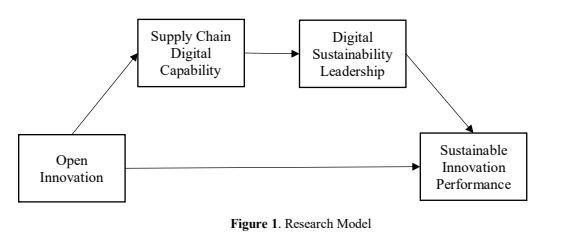
Taken together, this research posits that open innovation intensity enhances supply chain digital capability, which in turn strengthens digital sustainability leadership, ultimately improving sustainable innovation performance. Iran provides a timely empirical setting because the nation’s manufacturing sector is undergoing an industrial modernization process that simultaneously involves digital upgrading and sustainability transformation. Yet little is known about the internal mechanisms that determine whether open innovation collaboration results in sustainability performance under such conditions. By exploring these linkages, this study offers insight into how firms can convert innovation collaboration into digitally enabled environmental outcomes across their supply chain networks.
THEORETICAL FRAMEWORK AND HYPOTHESES DEVELOPMENT
The goal of this study is to explain how open innovation collaboration translates into sustainable innovation performance within supply chain networks. Although open innovation has been widely promoted as a mechanism for accessing external ideas and accelerating technological learning, research shows that collaboration does not automatically generate organizational benefits (Ahmadimousaabad et al., 2013; Ghasemi et al., 2016; Mobarakabadi & Karami, 2014). Instead, the value of open innovation depends on a firm’s ability to integrate acquired knowledge with internal processes and strategic priorities. Building on capability-based theory and digital transformation research, this study argues that two internal mechanisms are essential for converting collaborative innovation into sustainability outcomes: supply chain digital capability and digital sustainability leadership. The following subsections provide the theoretical development for each link in the proposed model.
Open Innovation Intensity and Supply Chain Digital Capability
Open innovation intensity refers to the extent to which firms engage in collaborative innovation activities with external partners including suppliers, logistics providers, technology vendors, and customers to co- develop or exchange knowledge, technologies, and innovative solutions (Xue et al., 2025). While high levels of collaboration increase access to external expertise and digital tools, the mere inflow of knowledge is insufficient if firms cannot integrate that knowledge into operational and technological processes(Ullah et al., 2016). Supply chain digital capability represents a firm’s ability to deploy, integrate, and leverage digital technologies to support real time visibility, analytics driven decision making, and coordinated supply chain operations (Slater et al., 2006). These capabilities are developed cumulatively as firms learn from technologically sophisticated partners and adopt external technological solutions to improve compatibility, data interoperability, and digital workflow automation (Yang et al., 2025).
Prior empirical research suggests that firms engaged in open innovation are more likely to invest in digital technologies and build internal technological competency because external collaboration exposes them to advanced digital practices and raises the need for shared information systems. Moreover, collaboration with digitalized partners can create institutional pressure to modernize digital infrastructure in order to align data formats, visibility systems, and communication protocols. Thus, open innovation intensity is expected to stimulate the development of digital capability in supply chain operations.
H1: Open innovation intensity positively influences supply chain digital capability. Supply Chain Digital Capability and Digital Sustainability Leadership
Although digital capability enhances visibility and coordination across the supply chain, technologies do not independently drive sustainability transformation (Esangbedo et al., 2024). Leadership determines whether digital systems are directed toward cost efficiency alone or toward broader environmental goals (Sun & Zhang, 2025). Digital sustainability leadership represents a leadership orientation in which decision makers strategically integrate digital transformation with sustainability objectives by defining long term ecological priorities, communicating shared expectations, and fostering collaboration among supply chain actors (Yu et al., 2025).
Supply chain digital capability provides leaders with the information and tools necessary to identify environmental hotspots, evaluate sustainability opportunities, and monitor progress (Shatila, 2025). Digital platforms such as carbon dashboards, energy tracking tools, and IoT enabled waste monitoring systems enable leaders to make evidence-based sustainability decisions. Furthermore, when digital technologies automate routine collaboration and information exchange, leadership can shift its attention from operational firefighting toward strategic sustainability planning. Thus, digital capability does not replace leadership but rather empowers leaders to conceptualize and implement sustainability driven transformation.
H2: Supply chain digital capability positively influences digital sustainability leadership. Digital Sustainability Leadership and Sustainable Innovation Performance
Sustainable innovation performance refers to the degree to which innovation efforts result in improved environmental outcomes, such as emissions reduction, energy efficiency, resource circularity, pollution prevention, and strengthened ESG readiness (Karami et al., 2016; Majumdarr et al., 2025). Digital sustainability leadership enhances these outcomes by framing sustainability as a strategic priority, encouraging experimentation with environmentally oriented innovations, championing digital tools that support sustainability, and motivating supply chain partners to collaborate on environmental improvement initiatives (García-Morales et al., 2012).
Leaders with a digital sustainability orientation play an essential role in overcoming resistance to change, aligning cross functional teams around sustainability goals, and embedding ecological considerations into product development, logistics improvements, and supply chain planning. Leadership also influences how firms engage external partners on sustainability matters, enabling coordinated industry action rather than isolated internal initiatives. Accordingly, digital sustainability leadership is positioned as a driver of environmental performance outcomes.
H3: Digital sustainability leadership positively influences sustainable innovation performance. Mediation Effects
Although open innovation provides exposure to advanced sustainability practices, the benefits are realized only through internal transformation processes (Afriyie et al., 2019). First, supply chain digital capability acts as a mechanism that converts collaborative innovation into a foundation of digital infrastructure and data visibility. Second, digital sustainability leadership acts as a mechanism that transforms this capability into sustainability outcomes by directing digital efforts toward environmental targets and motivating supply chain actors to participate (Cui et al., 2023).
These links form a capability–leadership sequence: external innovation produces digital capability; digital capability empowers sustainability leadership; sustainability leadership yields environmental performance (Karami, 2025). Without digital capability, leaders lack the visibility required to guide sustainability transformation; without leadership, capability remains technologically strong but strategically directionless. Thus, both mechanisms are necessary to translate open innovation into sustainability value.
H4: Supply chain digital capability mediates the effect of open innovation intensity on digital sustainability leadership.
H5: Digital sustainability leadership mediates the effect of supply chain digital capability on sustainable innovation performance.
H6: A sequential mediation exists such that open innovation intensity improves sustainable innovation performance through supply chain digital capability and digital sustainability leadership.
METHODOLOGY
A quantitative research design was employed to examine the capability–leadership transmission mechanism linking open innovation intensity, supply chain digital capability, and sustainable innovation performance. Partial Least Squares Structural Equation Modeling (PLS-SEM) was selected due to its suitability for complex mediation structures, prediction-oriented analysis, and non-normal data distributions common in organizational surveys (Hair & Alamer, 2022).
Data were collected from Iranian manufacturing firms registered with the Ministry of Industry, Mine and Trade (MIMT). Firms were selected across major industrial regions including Tehran, Isfahan, East Azerbaijan, and Khorasan Razavi to ensure adequate sectoral diversity. Respondents were targeted based on involvement in supply chain, innovation, operations, or sustainability decision making. A total of 600 questionnaires were distributed, and 232 valid responses were retained after data screening, resulting in a 38.7% response rate. Respondent and firm characteristics are displayed in Table 1.
Table 1. Respondent and Firm Demographics
|
Variable |
Category |
Frequency |
Percentage |
|
Respondent Role |
Supply chain manager |
78 |
33.6% |
|
Operations manager |
67 |
28.9% |
|
|
Sustainability / ESG manager |
52 |
22.4% |
|
|
Top management |
35 |
15.1% |
|
|
Firm Size (Employees) |
< 50 |
70 |
30.2% |
|
50–249 |
109 |
47.0% |
|
|
≥ 250 |
53 |
22.8% |
|
|
Export Intensity |
Domestic focus |
104 |
44.8% |
|
Mixed export/import |
83 |
35.8% |
|
|
Export oriented |
45 |
19.4% |
|
|
Total |
— |
232 |
100% |
All constructs were operationalized using five-point Likert scales (1 = strongly disagree; 5 = strongly agree). Items were adapted from validated literature and contextualized for supply chain operations. Supply chain digital capability was modeled as a reflective construct comprising the firm’s ability to deploy and integrate digital technologies to support visibility and coordinated decision making across the supply chain. A complete overview of constructs, conceptual domains, and measurement item codes is presented in Appendix A and Table 2.
Table 2. Constructs and Measurement Items
|
Construct |
Conceptual Domain |
Item Codes |
Description |
|
Open Innovation Intensity (OII) |
Collaboration and knowledge acquisition from supply chain partners |
OII1–OII5 |
Extent of external collaboration and knowledge integration |
|
Supply Chain Digital Capability (SCDC) |
Deployment and integration of digital technologies for supply chain visibility and decision making |
SCDC1– SCDC9 |
Ability to integrate technologies such as IoT, ERP, analytics, and digital platforms |
|
Digital Sustainability Leadership (DSL) |
Leadership orientation integrating digital transformation and sustainability |
DSL1– DSL5 |
Leaders’ strategic role in aligning digital initiatives with environmental objectives |
|
Sustainable Innovation Performance (SIP) |
Environmental outcomes of innovation |
SIP1– SIP5 |
Emissions reduction, resource efficiency, circularity, and ESG readiness |
To reduce common method bias, procedural remedies included survey anonymity, mixing scale formats, randomizing construct item order, and separating predictor and outcome variables into different sections. Statistical checks confirmed that Harman’s single-factor test did not indicate dominance of one factor, and full collinearity VIF values were below 3.3, suggesting no substantial bias.
Data were analyzed in Smart-PLS 4.0. The analysis process involved two sequential steps: (1) evaluation of the measurement model, including reliability, convergent validity, and discriminant validity, and (2) assessment of the structural model, including path estimates, effect sizes, mediation tests, model fit indices, and predictive relevance.
RESULTS
The measurement model was evaluated prior to testing the structural relationships. Indicator reliability, internal consistency reliability, and convergent and discriminant validity were all satisfactory. Standardized factor loadings exceeded 0.70 and were statistically significant (p < 0.001). Cronbach’s alpha and composite reliability (CR) values surpassed 0.85 for all constructs, indicating strong internal consistency. The average variance extracted (AVE) exceeded the recommended threshold of 0.50, confirming convergent validity. The Heterotrait–Monotrait Ratio (HTMT) values were below 0.85 for all construct pairs, confirming discriminant validity. A summary of measurement model results is provided in Table 3.
Table 3. Measurement Model Results
|
Construct |
Cronbach’s α |
CR |
AVE |
HTMT (max) |
Outcome |
|
OII |
0.87 |
0.91 |
0.68 |
0.83 |
Valid |
|
SCDC |
0.93 |
0.95 |
0.69 |
0.82 |
Valid |
|
DSL |
0.91 |
0.94 |
0.70 |
0.79 |
Valid |
|
SIP |
0.90 |
0.93 |
0.69 |
0.78 |
Valid |
After confirming measurement adequacy, the structural model was assessed using 5,000 bootstrap subsamples. The model demonstrated strong explanatory power: R² values were 0.49 for supply chain digital capability, 0.52 for digital sustainability leadership, and 0.44 for sustainable innovation performance. Predictive relevance (Q²) values were above 0.30 for all endogenous constructs, indicating high predictive validity. Standardized path coefficients, significance levels, and results of direct and indirect effects are shown in Table 4.
Table 4. Structural Model Results
|
Hypothesis |
Path |
β |
t-value |
p-value |
Result |
|
H1 |
OII → SCDC |
0.42 |
> 6.0 |
< 0.001 |
Supported |
|
H2 |
SCDC → DSL |
0.46 |
> 7.0 |
< 0.001 |
Supported |
|
H3 |
DSL → SIP |
0.40 |
> 5.0 |
< 0.001 |
Supported |
|
H4 |
OII → SCDC → DSL |
0.19 |
— |
< 0.001 |
Supported |
|
H5 |
SCDC → DSL → SIP |
0.18 |
— |
< 0.01 |
Supported |
|
H6 |
OII → SCDC → DSL → SIP |
0.13 |
— |
< 0.01 |
Supported |
The model fit index (SRMR = 0.067) fell below the 0.08 threshold, indicating a satisfactory fit between the data and the theoretical model. No multicollinearity concerns were observed, with VIF values below
3.3 for all indicators. Collectively, these results confirm that the proposed capability–leadership transmission mechanism is statistically robust.
The findings show that open innovation intensity enhances supply chain digital capability, digital capability enables digital sustainability leadership, and leadership ultimately improves sustainable innovation performance. Additionally, the sequential indirect pathway supports the argument that open innovation yields environmental benefits only when digital capability and sustainability-oriented leadership coexist.
DISCUSSION
The objective of this study was to understand how open innovation collaboration can be translated into sustainable innovation performance in Iranian manufacturing supply chains. The empirical results provide strong evidence that collaboration with external partners does not produce sustainability outcomes automatically; instead, it generates environmental benefits only when firms develop the internal mechanisms required to absorb and apply external knowledge. Specifically, the findings highlight the central importance of supply chain digital capability as a technological foundation that enables firms to transform externally acquired innovation into actionable digital support for visibility, analytics-based decision making, and coordination across the supply chain (Sun & Zhang, 2025). Without such capability, open innovation merely increases knowledge inflow without providing the infrastructure needed to operationalize it.
A second key contribution arises from the role of digital sustainability leadership. While digital capability enhances the technological readiness of the supply chain, technology alone does not shape environmental outcomes. Digital sustainability leadership is the mechanism through which firms convert digital capacity into environmental action by prioritizing sustainability objectives, directing digital resources toward emissions reduction and resource efficiency, and motivating internal teams and supply chain partners to participate in eco-innovation. The results demonstrate that leadership does not moderate the influence of digital capability but instead mediates it. Leaders rely on digitally generated insights such as real time environmental dashboards, energy monitoring tools, or waste analytics to establish priorities and drive transformative behavior. Thus, leadership becomes the human force that translates digital capability into measurable sustainability results.
By validating the sequential mediation from open innovation intensity to sustainable innovation performance through supply chain digital capability and digital sustainability leadership (Anjum et al., 2012), this study provides an integrated account of how innovation collaboration yields sustainability value. The findings advance theory by positioning sustainability transformation in supply chains not as a direct consequence of technology or collaboration alone but as an emergent outcome of a capability–
leadership pathway. Open innovation enhances digital capability; digital capability empowers sustainability-oriented leadership; and leadership directs environmental performance change. This refined mechanism helps explain inconsistent findings in previous research, where either technology or collaboration alone was examined without considering the leadership layer that determines whether digital systems are used for environmental impact or purely operational efficiency.
From a managerial standpoint, the findings underscore that firms wishing to improve sustainability performance should focus not only on collaborating with external partners or investing in digital tools but also on cultivating leaders capable of integrating digital transformation with sustainability objectives. Supply chain digital capability must be treated as a strategic enabler rather than a technical add-on, while leadership development must include competency building in digital strategy and environmental governance. Policymakers may also draw from these findings by designing support programs that encourage both technological modernization and leadership development to foster digitally enabled sustainability transformation in supply chains.
CONCLUSION
This study investigated how open innovation collaboration can be translated into sustainable innovation performance in Iranian manufacturing supply chains. The findings demonstrate that collaboration with external partners becomes environmentally valuable only when organizations develop internal mechanisms that enable the absorption and application of digital knowledge. Open innovation intensity strengthens supply chain digital capability, which provides the technological infrastructure necessary for real time visibility and coordinated decision making across supply chain operations. Digital sustainability leadership then transforms this capability into sustainability outcomes by aligning digital transformation with environmental priorities and motivating internal teams and supply chain partners toward eco- innovation (Yu et al., 2025). The validated sequential mediation highlights that sustainability is not an automatic consequence of external collaboration or technology investment, but rather the result of a capability–leadership pathway. By clarifying the role of supply chain digital capability and sustainability- oriented leadership in mediating the impact of open innovation on sustainability outcomes, this study advances theoretical understanding of digitally enabled environmental transformation.
Although the study offers valuable insights, several limitations provide opportunities for future research. First, the data were collected from single respondents within each firm, which may introduce subjective bias despite efforts to control for common method variance through procedural and statistical techniques. Future research could strengthen external validity by incorporating multi-informant survey designs or objective environmental indicators such as ESG disclosures, carbon audits, or energy usage records. Second, the cross-sectional design restricts the ability to examine causality or the temporal sequence of transformation. Because digital capability development and sustainability performance often unfold over time, longitudinal studies would help capture the lag between digital investment and environmental results. Third, the empirical context was limited to Iranian manufacturing firms. Although Iran offers a relevant setting due to simultaneous digitalization and sustainability pressures, replicating the model in different regions or industry types could reveal contextual influences. Fourth, the dependent variable focused on sustainable innovation performance rather than financial or operational outcomes. While this focus was appropriate for understanding environmental value creation, future research could examine how sustainability improvements mediated by leadership affect financial outcomes such as profitability, cost efficiency, and supply chain resilience. Finally, potential moderating variables such as institutional pressure, digital infrastructure readiness, or environmental turbulence could be examined to broaden understanding of the conditions that strengthen or weaken the capability–leadership transmission mechanism.
ACKNOWLEDGEMENTS:
The author would like to acknowledge the individuals, institutions, and organizations that provided support, guidance, or assistance during the development of this research.
FUNDING SOURCES:
The author received no financial support for the research, authorship, and/or publication of this article.
CONFLICT OF INTEREST:
The author declares no conflict of interest.
REFERENCES
-
Afriyie, S., Du, J., & Ibn Musah, A.-A. (2019). Innovation and marketing performance of SME in an emerging economy: the moderating effect of transformational leadership. Journal of Global , 9 (1), 40.
-
Ahmadimousaabad, A., Bajuri, N., Jahanzeb, A., Karami, M., & Rehman, S. (2013). Trade-off theory, pecking order theory and market timing theory: a comprehensive review of capital structure theories. International Journal of Management and Commerce Innovations , 1 (1), 11-18.
-
Anjum, M. J., Ali, S. M., Sadiq, M., Karami, M., & Khan, S. (2012). Exploring the nexus: management practices, innovation and firm performance. World Applied Sciences Journal , 19 (6), 785-794.
-
Cui, R., Wang, J., & Zhou, C. (2023). Exploring the linkages of green transformational leadership, organizational green learning, and radical green innovation. Business Strategy and the Environment , 32 (1), 185-199.
-
Esangbedo, C. O., Zhang, J., Perez, P. B., & Skitmore, M. (2024). Sustainable performance and supply chain leadership in logistic firms: the role of corporate sustainability strategies and digital supply chain. Supply Chain Management: An International Journal , 29 (6), 963-977.
-
García-Morales, V. J., Jiménez-Barrionuevo, M. M., & Gutiérrez-Gutiérrez, L. (2012). Transformational leadership influence on organizational performance through organizational learning and innovation. Journal of business research , 65 (7), 1040-1050.
-
Ghasemi, R., Azmi Mohamad, N., Karami, M., Hafiz Bajuri, N., & Asgharizade, E. (2016). The mediating effect of management accounting system on the relationship between competition and managerial performance. International Journal of Accounting and Information Management , 24 (3), 272-295.
-
Ghasemi, R., Habibi, H. R., Ghasemlo, M., & Karami, M. (2019). The effectiveness of management accounting systems: evidence from financial organizations in Iran. Journal of Accounting in Emerging , 9 (2), 182-207.
-
Hair, J., & Alamer, A. (2022). Partial Least Squares Structural Equation Modeling (PLS-SEM) in second language and education research: Guidelines using an applied example. Research Methods in Applied , 1 (3), 100027.
-
Karami, M. (2025). DIGITAL ENTREPRENEURSHIP AND CROSS BORDER TRADE PERFORMANCE IN EMERGING ECONOMIES: THE MEDIATING ROLES OF INNOVATION
CAPABILITY AND INSTITUTIONAL SUPPORT. TMP Universal Journal of Law, Business, and , 1 (2).
-
Karami, M., Hozhabri, A. A., Ghasemi, R., & Bakar, A. H. A. (2016). Market orientation and performance relationship with respect to the manufacturing industry. International Journal of Business Performance and , 8 (4), 348-370.
-
Majumdarr, S., Dasgupta, S. A., Hassan, Y., Behl, A., & Pereira, V. (2025). Linking digital transformational leadership, symmetrical internal communication with innovation capability: a moderated mediation model. Journal of Knowledge Management , 29 (8), 2478-2496.
-
Mobarakabadi, H., & Karami, M. (2014). Investigation of relationship among the organizational culture and creativity. Research Journal of Applied Sciences, Engineering and Technology , 7 (19), 4069-4071.
-
Shatila, K. (2025). Artificial intelligence and organizational resilience: the mediating role of agility, innovation, and digital leadership. Strategy & Leadership , 1-25.
-
Singh, K., Chaudhuri, R., & Chatterjee, S. (2025). Assessing the impact of digital transformation on green supply chain for achieving carbon neutrality and accelerating circular economy initiatives. Computers & , 201 , 110943.
-
Slater, S. F., Olson, E. M., & Hult, G. T. M. (2006). The moderating influence of strategic orientation on the strategy formation capability–performance relationship. Strategic management journal , 27 (12), 1221- 1231.
-
Sun, Y., & Zhang, Q. (2025). Navigating the digital transformation of commercial banks: Embracing innovation in customer emotion analysis. Journal of the Knowledge Economy , 16 (1), 3440-3461.
-
Ullah, M. I., Ab Hamid, K. B., & Shahzad, A. (2016). Impact of Transformational Leadership on Knowledge Sharing of Employees and Innovation Capability in the Dairy Sector of Pakistan. Pakistan Journal of Social , 36 (1).
-
Xue, C., Wang, J., & Torres de Oliveira, R. (2025). Digital Capability and Radical Green Innovation: The Role of Organizational Resilience and Environmental Dynamism. Corporate Social Responsibility and .
-
Yang, Z., Dong, M., Guo, H., & Peng, W. (2025). Empowering resilience through digital transformation intentions: synergizing knowledge sharing and transformational leadership amid COVID-19. Journal of , 38 (1), 59-81.
-
Yu, Y., Zeng, H., & Zhang, M. (2025). Digital transformation for supply chain collaborative innovation and market performance. European Journal of Innovation Management , 28 (6), 2446-2468.
Appendix A— Measurement Items
All constructs were measured using a five-point Likert scale ranging from 1 = strongly disagree to 5 = strongly agree, and item wording was adapted to the supply chain context of Iranian manufacturing firms.
Open Innovation Intensity (OII)
Reflects the extent of innovation collaboration and external knowledge exchange within the supply chain.
-
OII1: We frequently exchange innovation knowledge with our supply chain partners.
-
OII2: Insights from suppliers, logistics providers, and customers significantly influence our innovation decisions.
-
OII3: We actively collaborate with supply chain partners to co-develop new digital or sustainability-oriented solutions.
-
OII4: We rely on technology sharing and information transfer with supply chain partners to support innovation activities.
-
OII5 : Joint innovation initiatives with supply chain partners play a central role in our transformation strategy.
Supply Chain Digital Capability (SCDC)
Measures the organization’s ability to deploy and integrate digital technologies to support supply chain visibility and decision making.
Digital Deployment
-
SCDC1: We widely deploy digital technologies across our supply chain operations.
-
SCDC2: Our supply chain functions are supported by integrated digital platforms.
-
SCDC3 : Our digital tools improve the speed and accuracy of supply chain decisions.
Digital Integration
-
SCDC4: We integrate data from different supply chain functions into a unified digital system.
-
SCDC5: Digital information flows smoothly across the supply chain without manual intervention.
-
SCDC6 : Our digital systems provide real time visibility into supply chain processes.
Digital Analytics and Decision Support
-
SCDC7: We use analytics and dashboards to make informed supply chain decisions.
-
SCDC8: Digital tools help us identify inefficiencies and improvement opportunities across the supply chain.
-
SCDC9 : We use digital technologies to coordinate and align decisions among supply chain teams.
Digital Sustainability Leadership (DSL)
Reflects leadership orientation toward integrating digital transformation and sustainability.
-
DSL1: Our leaders actively guide digital and sustainability initiatives across the supply chain.
-
DSL2: Leadership emphasizes the strategic alignment of digital transformation with environmental goals.
-
DSL3: Leaders communicate a clear sustainability vision supported by digital innovation.
-
DSL4: Leaders prioritize emissions reduction, resource efficiency, and eco-innovation using digital technologies.
-
DSL5: Leaders motivate internal teams and supply chain partners to adopt and support digital sustainability practices.
Sustainable Innovation Performance (SIP)
Represents sustainability outcomes resulting from supply chain innovation efforts.
-
SIP1: Our supply chain has reduced emissions and waste through innovation initiatives.
-
SIP2: Digital and sustainability efforts have increased resource efficiency across supply chain operations.
-
SIP3: We have improved our ability to develop environmentally friendly products or processes.
-
SIP4: We achieve sustainability targets faster than competing firms in our industry.
-
SIP5: Collaboration across the supply chain has strengthened our ESG compliance and sustainability reporting capability.
-