
DIGITAL ENTREPRENEURSHIP AND CROSS BORDER TRADE PERFORMANCE IN EMERGING ECONOMIES: THE MEDIATING ROLES OF INNOVATION CAPABILITY AND INSTITUTIONAL SUPPORT
Meisam Karami1*
1Department of Management, Universiti Teknologi Malaysia, Johor, Malaysia, 81310
Corresponding Author: Meisam Karami Email: meisam.karami100@gmail.com
ABSTRACT
Digital transformation is reshaping how small and medium sized enterprises (SMEs) expand across borders, yet evidence from emerging economies remains limited. This study investigates how digital entrepreneurship (DE) influences cross border trade performance (CBTP) through the mediating roles of innovation capability (IC) and institutional support (IS). Drawing on the resource-based view and institutional theory, data were collected from 154 export oriented Iranian SMEs and analyzed using SmartPLS 4. The results show that DE enhances CBTP only indirectly: both IC and IS fully mediate the DE–performance relationship, while the direct effect is nonsignificant. These findings indicate that digitalization contributes to export success only when firms develop innovation capabilities and operate within supportive institutional environments. The study advances theoretical integration of internal capabilities and external institutions and provides actionable implications for managers and policymakers seeking to strengthen digital internationalization in emerging economies.
Keywords: Digital entrepreneurship; Innovation capability; Institutional support; Cross border trade performance.
INTRODUCTION
Digital transformation has reshaped how firms identify opportunities and compete internationally. Technologies such as data analytics, cloud platforms, and artificial intelligence have expanded the reach of digital entrepreneurship (DE), enabling small and medium sized enterprises (SMEs) to overcome traditional barriers to internationalization (Mishra, 2024; van Luik et al., 2020). By reducing information gaps and transaction costs, digital tools allow SMEs to connect with global customers, coordinate supply chains, and scale operations efficiently.
However, most evidence on DE and performance comes from developed economies with mature institutional systems. Emerging economies present contrasting conditions: institutional voids, regulatory inconsistencies, and infrastructural gaps often limit firms’ ability to convert digital adoption into export performance (Ravenscroft et al., 2012; Zaki, 2019). This raises uncertainty about whether DE produces similar outcomes under less supportive conditions.
Iran reflects this complexity. Despite rapid digitalization and government led initiatives, many SMEs face uneven institutional support that slows the integration of digital tools into export activities. This combination of technological progress and institutional constraint makes Iran a relevant context for examining how DE interacts with internal capabilities and external structures to shape cross-border trade performance (CBTP).
Previous studies typically analyze innovation capability (IC) or institutional support (IS) separately. Few assess their simultaneous roles in explaining how DE relates to CBTP in emerging markets (Caliskan et al., 2021; Ganuthula, 2025). This study addresses this gap through a dual mediation model in which DE influences CBTP indirectly through IC and IS. Grounded in the resource-based view (Barney, 1991; Sánchez-García et al., 2025; Tang et al., 2023) and institutional theory (Faroque et al., 2022), this research argues that DE fosters internal innovation capability and enhances access to institutional support. Using data from 154 Iranian SMEs, the study evaluates this integrated model and contributes new evidence from a region underrepresented in the digital entrepreneurship literature.
LITERATURE REVIEW AND HYPOTHESES DEVELOPMENT
Digital Entrepreneurship and Cross Border Trade Performance
Digital entrepreneurship (DE) has evolved from a niche phenomenon into a mainstream business practice driving global competitiveness. It represents the intersection of entrepreneurship, technology, and innovation, characterized by the strategic exploitation of digital technologies to identify, evaluate, and pursue new opportunities (Mishra, 2024; van Luik et al., 2020). DE extends beyond simply adopting e-commerce or social media; it involves reimagining business models and value creation processes in digital ecosystems. The ubiquity of digital platforms allows firms especially small and medium sized enterprises (SMEs) to access global markets with unprecedented efficiency (Huy & Phuc, 2025). By reducing geographic constraints, digital tools such as data analytics, cloud computing, and customer relationship management systems enable SMEs to develop new products, manage customer relationships, and coordinate supply chains across borders.
Cross border trade performance (CBTP) reflects a firm’s ability to generate and sustain international revenues, expand market share, and enhance brand legitimacy in foreign markets (John et al., 2025). In digitally connected economies, performance increasingly depends on a firm’s capability to integrate digital channels into internationalization strategies. However, empirical evidence on the DE–CBTP relationship remains mixed. Studies in developed contexts (e.g., Germany, South Korea, and Finland) often report positive effects of digitalization on export intensity (Mishra, 2024; van Luik et al., 2020), while research in developing and emerging economies yields more nuanced findings. For instance, (Caliskan et al., 2021) found that Vietnamese SMEs adopted digital technologies widely but struggled to convert adoption into sustained export growth due to weak logistics and institutional bottlenecks. Similarly, Ganuthula (2025) observed that Indian firms’ digital transformation had limited impact on export revenues unless supported by institutional infrastructure such as online trade facilitation and financing schemes.
These inconsistencies highlight that DE alone may not guarantee superior international performance. Its success depends on how effectively digital initiatives are translated into
tangible outcomes through innovation and supportive institutions. DE enhances firms’ ability to gather market intelligence, engage customers globally, and implement flexible supply chain solutions. However, in emerging economies where institutional voids and policy volatility constrain entrepreneurial initiatives the direct influence of DE on performance may be insufficient. As (Ravenscroft et al., 2012) argue, firms in such environments must compensate for institutional weaknesses through adaptive strategies and innovative processes. Consequently, DE’s effect on CBTP is likely indirect, mediated through mechanisms that convert digital potential into realized value.
H1: Digital entrepreneurship has a positive effect on cross border trade performance among SMEs in emerging economies.
Integrating the Resource-Based View and Institutional Theory
This study integrates the resource-based view (RBV) and institutional theory to provide a comprehensive framework explaining how digital entrepreneurship influences cross border trade performance. RBV posits that firms achieve sustainable competitive advantage through valuable, rare, inimitable, and non-substitutable (VRIN) resources (Barney, 1991). Capabilities such as digital orientation, knowledge sharing, and innovation are dynamic resources that enhance adaptability and performance. Within this framework, digital entrepreneurship functions as a dynamic capability it enables firms to sense and seize opportunities, reconfigure resources, and achieve strategic renewal in rapidly changing environments (Kraus et al., 2019). DE allows SMEs to respond to technological turbulence by integrating digital knowledge into their value creation systems. In contrast, institutional theory emphasizes the external context in which firms operate. Institutions defined as the formal and informal “rules of the game” shape organizational behavior and outcomes (Faroque et al., 2022). In developed economies, robust institutions facilitate entrepreneurship by ensuring property rights, stable regulation, and efficient markets. However, in emerging economies, institutional voids weak enforcement, limited financial markets, and fragmented policies constrain firm growth (Zaki, 2019). Institutional support mechanisms such as trade promotion programs, digital infrastructure, and government incentives can therefore play a pivotal role in enabling firms to convert entrepreneurial efforts into performance.
The integration of RBV and institutional theory acknowledges that internal resources and external conditions are interdependent.
-
From the RBV perspective, DE builds innovation capability (IC) , an internal resource that transforms knowledge and technology into competitive advantage.
-
From the institutional perspective, DE enhances institutional support (IS) by increasing visibility and legitimacy, allowing firms to access external resources such as financing, training, and market intelligence.
This dual theoretical foundation explains how DE affects performance through internal transformation (IC) and external facilitation (IS). It also aligns with calls for hybrid theories that bridge firm centric and environment centric approaches to explain entrepreneurship in emerging economies (Madhani, 2010).
Digital Entrepreneurship and Institutional Support
Institutional support (IS) refers to the formal systems, policies, and resources provided by governments and organizations to foster entrepreneurship and internationalization. These include access to export financing facilities, digital infrastructure, trade training, and regulatory frameworks that reduce transaction costs. According to Zaki (2019), institutional support in emerging markets acts as a substitute for missing market mechanisms by providing legitimacy,
credibility, and access to scarce resources. When institutions offer predictable rules and support mechanisms, firms can allocate resources more efficiently, mitigating uncertainty.
Digital entrepreneurship often increases firms’ access to institutional support. Digitally active SMEs are more visible to policymakers and are often prioritized in national innovation and export strategies. For instance, the Iranian Ministry of Industry and the E-Commerce Development Center have recently launched programs to assist SMEs in adopting e-commerce platforms for international trade. These initiatives target firms that already exhibit digital readiness, signaling to institutions that such businesses are credible and scalable partners for policy objectives (Iran Chamber of Commerce, 2024). Similar patterns are observed in Indonesia and Malaysia, where governments promote digital exporters through tax incentives and capacity building schemes (Jöhnk et al., 2021).
Empirical studies also support this connection. Yimam et al. (2025) found that Chinese firms with higher levels of digital maturity received more government subsidies for R&D and export operations. Yan et al. (2025) reported that digital entrepreneurship enhances firms’ ability to navigate bureaucratic procedures and access institutional benefits. Thus, DE acts as both a signal and a catalyst firm that strategically employs digital technologies demonstrate legitimacy and capability, making them attractive recipients of institutional resources.
H2: Digital entrepreneurship positively influences institutional support available to SMEs engaged in international business.
Digital Entrepreneurship and Innovation Capability
Innovation capability (IC) reflects a firm’s ability to generate, adopt, and implement new ideas, products, and processes that enhance competitiveness (Sánchez-García et al., 2025; Tang et al., 2023). In the RBV framework, IC represents a dynamic capability that transforms resources into value creating outcomes. Digital entrepreneurship provides the technological and cognitive foundation for this transformation. Through digitalization, firms can integrate global knowledge, automate processes, and engage in continuous experimentation. Empirical evidence underscores DE’s role in stimulating innovation. (Mishra, 2024) show that digital oriented SMEs develop superior innovation performance due to data driven learning and collaboration with stakeholders. van Luik et al. (2020) highlight that digital platforms foster rapid prototyping and customer feedback loops, accelerating innovation cycles. For Iranian SMEs, digital entrepreneurship compensates for limited access to physical R&D infrastructure by enabling participation in virtual innovation networks and cross border collaborations. This capacity to innovate through digital means allows firms to customize offerings for specific export markets, a key determinant of CBTP. Digital entrepreneurship also supports organizational learning and absorptive capacity essential precursors of innovation capability. Firms that exploit analytics and online communication channels develop a deeper understanding of customer needs, which feeds back into design and development processes. Hence, DE appears to support digital scaffolding that sustains innovation-based growth.
H3: Digital entrepreneurship positively influences firms’ innovation capability.
Innovation Capability and Cross Border Trade Performance
Innovation capability is associated with higher export competitiveness. Firms with strong IC can adapt products to diverse market requirements, achieve cost efficiencies, and respond flexibly to foreign demand fluctuations. Innovation oriented SMEs are also more resilient to crises and institutional changes, maintaining international operations even under uncertainty (Cheng & Yang, 2017). In addition, innovation fosters legitimacy and reputation critical intangible assets that increase acceptance in foreign markets. The innovation–performance
relationship has been confirmed across industries and regions. For example, Yang et al. (2025) found that European SMEs with higher innovation intensity achieve faster export expansion. Caliskan et al. (2021) showed that innovation mediates the link between digital readiness and export performance among ASEAN SMEs. Within the Iranian context, where environmental turbulence and regulatory change are common, innovation enables firms to reconfigure strategies quickly. Iranian exporters in the food and textile sectors increasingly rely on product innovation, packaging adaptation, and process automation to meet international quality standards.
From an RBV perspective, innovation capability transforms digital knowledge into firm specific advantages. The ability to develop unique solutions based on digital insights helps SMEs escape price-based competition and move toward value added international segments.
H4: Innovation capability positively influences cross border trade performance.
Institutional Support and Cross Border Trade Performance
Institutional support is associated with higher export success. It mitigates the liabilities of smallness and foreignness by providing SMEs with access to networks, financing, and infrastructure (Migdadi, 2021). Well-designed institutional frameworks facilitate trust and coordination among market actors, reducing the cost of internationalization. In countries like Iran, where bureaucratic procedures and regulatory uncertainty create barriers to trade, institutional support can significantly improve performance by streamlining documentation, offering subsidized export insurance, or providing training on global trade regulations.
Empirical studies consistently highlight this link. Caliskan et al. (2021) observed that Vietnamese SMEs receiving state supported digital trade training achieved 25 % higher export growth than unsupported counterparts. John et al. (2025) demonstrated that institutional assistance moderates environmental risk and enhances foreign market commitment. In Iran, the Trade Promotion Organization and the Small Industries and Industrial Parks Organization provide partial export credit guarantees and information services, which substantially improve firms’ cross border trade performance. Institutional support can also be viewed as a form of external capability, a resource that firms access through legitimacy and network embeddedness. When combined with internal innovation, institutional support amplifies export performance by aligning firm strategy with policy incentives and infrastructure availability.
H5: Institutional support positively influences cross-border trade performance.
Dual Mediating Roles of Innovation Capability and Institutional Support
While DE enhances both innovation capability and institutional support, its effect on export performance may be largely indirect. These two mediators represent complementary but distinct mechanisms. Internally, innovation capability reflects how firms convert digital resources into competitive advantage through creativity, learning, and technological advancement. Externally, institutional support reflects the environment’s capacity to facilitate or constrain entrepreneurial outcomes. Parallel mediation is theoretically consistent with the RBV–Institutional integration. Within RBV, DE acts as a dynamic resource that builds IC; within institutional theory, DE legitimizes firms, allowing them to attract IS. Both mediators jointly explain how DE overcomes contextual constraints in emerging economies. Madhani (2010) argued that the interaction between firm resources and institutional frameworks determines performance more than either factor alone. Thus, DE’s success depends on its capacity to mobilize internal innovation and external support simultaneously.
Empirical evidence supports this dual mechanism. Yimam et al. (2025) found that DE
indirectly improves Chinese firms’ international performance through innovation capability and institutional quality. Mishra (2024) and Ganuthula (2025) similarly show that in transitional economies, the DE–performance link is fully mediated by resource transformation and institutional alignment. These findings suggest that digital adoption creates potential but realizing that potential requires both organizational innovation and institutional connectivity. In Iran, this dual mediation is particularly salient. While many SMEs adopt digital tools for marketing and communication, only those capable of innovating and engaging institutional programs achieve export success. Firms that lack innovation capability often stagnate, and those that fail to connect with support mechanisms remain excluded from global markets.
H6a: Innovation capability mediates the relationship between digital entrepreneurship and cross border trade performance.
H6b: Institutional support mediates the relationship between digital entrepreneurship and cross border trade performance.
Conceptual Framework
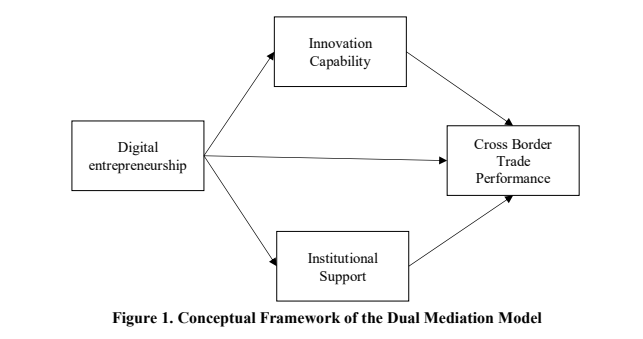
Figure 1 presents the proposed conceptual model. Digital entrepreneurship (independent variable) affects cross border trade performance (dependent variable) indirectly through two parallel mediators’ innovation capability (IC) and institutional support (IS). These paths capture the dual mechanisms through which digital strategies influence export outcomes: internal capability development and external institutional engagement. Control variables firm size, age, and sector are included to account for heterogeneity among SMEs.
RESEARCH METHODOLOGY
Research Design
This study adopted a quantitative, cross sectional survey design to test how digital entrepreneurship (DE) affects cross border trade performance (CBTP) through the parallel mediator’s innovation capability (IC) and institutional support (IS). A structured questionnaire was distributed to export-oriented SMEs. This design allows simultaneous estimation of multiple causal paths using partial least squares structural equation modeling (PLS-SEM), which is robust to non-normal data typical of emerging economies (Hair & Alamer, 2022). The
conceptual framework derived from the integrated resource-based view (RBV) and institutional theory (see Figure 1 in Section 2.8) guided all analyses. Construct definitions and item sources are summarized in Table 1 – Measurement Items and Sources.
Population and Sampling Procedure
The population comprised Iranian SMEs active in export manufacturing and services. Iran was selected as a representative emerging economy context combining rapid digitalization with evolving institutional structures. Sampling frames were drawn from (1) the Iran Chamber of Commerce, Industries, Mines and Agriculture (ICCIMA) directory and (2) industrial clusters in Tehran, Isfahan, and Shiraz.
A purposive, non-probability sampling technique was used with two inclusion criteria:
-
The firm had operated continuously for ≥ 3 years, and
-
It uses at least one digital technology (e-commerce, online marketing, or electronic payment).
Out of 220 distributed questionnaires, 154 valid responses were obtained (70 % response rate). Following (Hair & Alamer, 2022), a sample ≥ 90 is sufficient for a medium effect (0.30) in a model with three predictors at 0.80 power (α = 0.05); thus n = 154 was adequate. Because purposive sampling emphasizes theoretical rather than statistical representativeness, results are interpreted as context specific and exploratory.
Data Collection Procedure
Data was collected between April and June 2025 via both Google Forms and printed surveys at SME trade events. Respondents were owners, CEOs, or export managers with decision making authority. Participation was voluntary and anonymous; informed consent preceded all responses. Procedural controls minimized common method bias (CMB): randomized question order, reverse coded items, separation of predictor and outcome sections, and confidentiality assurances. Post-hoc diagnostics confirmed minimal bias. The Harman single factor test found the first factor explained 34.6 % variance below the 40 % threshold and the full collinearity VIF was < 3.3; both results appear in Table 3 – Common Method Bias and Model Diagnostics.
Measurement of Constructs
All items used five-point Likert scales (1 = strongly disagree to 5 = strongly agree). Scales were adapted from validated sources, translated into Persian, back translated, and pilot tested with ten managers for clarity. Each construct’s sample items and references appear in Table 1 – Measurement Items and Sources, while reliability and validity outcomes are reported in Table 2 – Reliability and Validity Statistics.
Table 1 – Measurement Items and Sources
|
Construct |
Example Items |
Key Sources |
|---|---|---|
|
Digital Entrepreneurship (DE) |
“Our firm uses digital tools to identify new market opportunities.” / “Our business model relies on online platforms for sales and customer interaction.” |
(Mishra, 2024; van Luik et al., 2020) |
|
Innovation Capability (IC) |
“We frequently introduce new products or processes.” / “Our firm encourages experimentation with digital technologies.” |
(Sánchez-García et al., 2025; Tang et al., 2023) |
|
Institutional Support |
“Government agencies provide programs that |
(Yan et al., 2025; |
|
(IS) |
assist our export activities.” / “Our firm benefits from digital trade infrastructure.” |
Zaki, 2019) |
|
Cross Border Trade Performance (CBTP) |
“Our export revenues have increased over the past three years.” / “We have entered new foreign markets recently.” |
(Cheng & Yang, 2017; John et al., 2025) |
Data Analysis Techniques
All analyses used SmartPLS 4 following a two-stage procedure: (1) measurement model evaluation and (2) structural model testing.
Stage 1 – Measurement Model
Reliability and validity statistics (Cronbach’s α, composite reliability [CR], average variance extracted [AVE], and HTMT) appear in Table 2 – Reliability and Validity Statistics. All α ≥ 0.86, CR ≥ 0.90, and AVE ≥ 0.64, confirming convergent validity. Discriminant validity was achieved when √AVE values exceeded inter-construct correlations (see Table 4 – Correlation Matrix) and HTMT ratios < 0.85.
Stage 2 – Structural Model
After confirming validity, structural paths were estimated with bootstrapping (5 000 resamples). Direct effects (DE → CBTP; DE → IC; DE → IS; IC → CBTP; IS → CBTP) and indirect effects (DE → IC → CBTP; DE → IS → CBTP) were tested. Results and significance levels are summarized in Section 4 and cross referenced to Table 3. Model fit indices (SRMR
= 0.062, NFI = 0.89, χ²/df = 2.28) met recommended thresholds and are reported in Table 3. Predictive power was assessed via R² and Q² (> 0), both indicating adequate model robustness.
Ethical Considerations
Respondents received written explanations of study purpose, voluntary participation, and confidentiality. No identifiable data was collected. Ethical approval followed institutional guidelines and the (Association, 2013).
Reliability and Validity Results
Psychometric outcomes for all constructs appear in Table 2 – Reliability and Validity Statistics. All measures exceed APA and PLS-SEM standards, confirming reliability and construct validity.
Table 2 – Reliability and Validity Statistics
|
Construct |
Cronbach’s α |
Composite Reliability |
AVE |
HTMT (Max) |
Status |
|---|---|---|---|---|---|
|
Digital Entrepreneurship |
0.89 |
0.92 |
0.68 |
0.79 |
Valid |
|
Innovation Capability |
0.88 |
0.91 |
0.66 |
0.81 |
Valid |
|
Institutional Support |
0.86 |
0.90 |
0.64 |
0.80 |
Valid |
|
Cross Border Trade Performance |
0.91 |
0.93 |
0.70 |
0.82 |
Valid |
Each construct’s √AVE appears on the diagonal of Table 4, confirming discriminant validity.
Common Method Bias, Multicollinearity, and Model Diagnostics
Diagnostic results are summarized in Table 3 – Common Method Bias and Model Diagnostics. Harman’s single factor variance (34.6 %) and full collinearity VIF (2.17 max) were below
critical levels; inner VIF ≤ 2.76 confirmed no multicollinearity. Overall fit indices (SRMR = 0.062; NFI = 0.89) indicate acceptable global fit.
Table 3 – Common Method Bias and Model Diagnostics
|
Diagnostic Test |
Criterion |
Observed Value |
Interpretation |
|---|---|---|---|
|
Harman’s Single Factor |
< 40 % variance |
34.6 % |
No CMB problem |
|
Full Collinearity VIF |
< 3.3 |
2.17 (max) |
No CMB problem |
|
Inner VIF |
< 5 |
2.76 (max) |
No multicollinearity |
|
SRMR |
≤ 0.08 |
0.062 |
Acceptable fit |
|
NFI |
≥ 0.85 |
0.89 |
Acceptable fit |
Correlation Matrix
Inter construct correlations appear in Table 4 – Correlation Matrix. Moderate positive relationships are observed between DE and both mediators (IC and IS), and between these mediators and CBTP. Diagonal √AVE values (expressed in bold) exceed off diagonal correlations, supporting discriminant validity.
Table 4 – Correlation Matrix
|
Constructs |
DE |
IC |
IS |
CBTP |
|---|---|---|---|---|
|
Digital Entrepreneurship (DE) |
0.82 |
– |
– |
– |
|
Innovation Capability (IC) |
0.58 |
0.81 |
– |
– |
|
Institutional Support (IS) |
0.53 |
0.49 |
0.80 |
– |
|
Cross Border Trade Performance (CBTP) |
0.44 |
0.59 |
0.61 |
0.84 |
Factor Loading Matrix
Indicator reliability was evaluated via factor loadings, all > 0.70 and cross loadings < 0.40 (see Table 5 – Factor Loadings of Measurement Items). These values confirm item specificity and one dimensionality.
Table 5 – Factor Loadings of Measurement Items
|
Construct |
Item Code |
Loading |
|---|---|---|
|
Digital Entrepreneurship |
DE1 |
0.82 |
|
DE2 |
0.84 |
|
|
DE3 |
0.80 |
|
|
DE4 |
0.83 |
|
|
Innovation Capability |
IC1 |
0.79 |
|
IC2 |
0.82 |
|
|
IC3 |
0.81 |
|
|
IC4 |
0.83 |
|
|
Institutional Support |
IS1 |
0.78 |
|
IS2 |
0.81 |
|
|
IS3 |
0.84 |
|
|
IS4 |
0.80 |
|
|
Cross Border Trade Performance |
CBTP1 |
0.83 |
|
CBTP2 |
0.85 |
|
|
CBTP3 |
0.86 |
|
|
CBTP4 |
0.82 |
RESULTS AND ANALYSIS
Measurement Model Assessment
Before estimating the structural relationships, the reliability and validity of all reflective constructs were examined. Results are summarized in Table 2 – Reliability and Validity Statistics (see Section 3.7). As reported, all constructs exceed the minimum reliability standards (Cronbach’s α > 0.70, CR > 0.80) and show satisfactory convergent validity (AVE > 0.50). Discriminant validity was verified using both the Fornell–Larcker criterion and HTMT ratios (< 0.85). The square roots of each construct’s AVE (displayed on the diagonal in Table 4 – Correlation Matrix) are greater than their corresponding inter construct correlations, confirming that each construct measures a distinct concept. Together, these results validate the measurement model, indicating that the items listed earlier in Table 1 – Measurement Items and Sources accurately represent their intended constructs.
Structural Model Evaluation
After confirming the measurement model, the hypothesized structural relationships were tested using SmartPLS 4 with bootstrapping (5 000 resamples). Path coefficients, t-statistics, and p- values are summarized in Table 6 – Structural Path Coefficients and Hypothesis Testing Results.
Table 6 – Structural Path Coefficients and Hypothesis Testing Results
|
Hypothesis |
Path |
β |
t |
p |
Decision |
|---|---|---|---|---|---|
|
H1 |
DE → CBTP |
0.07 |
1.05 |
0.293 |
Not supported |
|
H2 |
DE → IS |
0.53 |
7.82 |
< 0.001 |
Supported |
|
H3 |
DE → IC |
0.58 |
8.44 |
< 0.001 |
Supported |
|
H4 |
IC → CBTP |
0.34 |
4.63 |
< 0.001 |
Supported |
|
H5 |
IS → CBTP |
0.38 |
5.09 |
< 0.001 |
Supported |
|
H6a |
DE → IC → CBTP |
0.20 |
4.12 |
< 0.001 |
Supported |
|
H6b |
DE → IS → CBTP |
0.21 |
4.33 |
< 0.001 |
Supported |
The model explains substantial variance: R² = 0.67 for IC, R² = 0.61 for IS, and R² = 0.74 for CBTP. All predictive relevance indicators (Q² > 0) confirm adequate explanatory power.
Mediation Analysis
Mediation was tested through bootstrapped indirect effect estimates, with results shown in Table 7 – Mediation Effects of Innovation Capability and Institutional Support. Both mediators are significant: DE → IC → CBTP (β = 0.20, p < 0.001) and DE → IS → CBTP (β = 0.21, p
< 0.001). The direct path (DE → CBTP) became statistically insignificant once mediators were included, indicating full mediation. Hence, digital entrepreneurship enhances export performance primarily through the internal mechanism of innovation capability and the external mechanism of institutional support.
Table 7 – Mediation Effects of Innovation Capability and Institutional Support
|
Indirect Path |
β |
t |
p |
Mediation Type |
|---|---|---|---|---|
|
DE → IC → CBTP |
0.20 |
4.12 |
< 0.001 |
Full |
|
DE → IS → CBTP |
0.21 |
4.33 |
< 0.001 |
Full |
Model Fit and Diagnostic Indices
Global model fit statistics are summarized in Table 3 – Common Method Bias and Model Diagnostics (Section 3.8) and reiterated here for completeness. Values of SRMR = 0.062, NFI
= 0.89, and χ²/df = 2.28 meet recommended cut-offs. All inner VIF values (< 3.0) confirm the absence of multicollinearity. Thus, the model demonstrates acceptable global fit and reliability, reinforcing the robustness of the structural results reported in Table 6.
Control Variables
Control variables firm size, age, and sector were included in preliminary models. Their standardized coefficients were nonsignificant (p > 0.10) and were excluded from the final structural path diagram.
Interpretation of Findings
The empirical results illustrate several key patterns:
-
Digital entrepreneurship does not directly predict performance (H1 not supported). In Iran’s transitional economy, digital adoption alone does not yield export gains unless coupled with innovation and institutional mechanisms.
-
Innovation capability as internal mechanism. The significant DE → IC (H3) and IC → CBTP (H4) paths confirm that DE fosters internal learning and experimentation that enhance export competitiveness. Innovation mediates 20 % of the total effect.
-
Institutional support as external mechanism. The significant DE → IS (H2) and IS → CBTP (H5) paths show that digital entrepreneurs gain greater access to public programs and trade infrastructures. IS mediates 21 % of the total effect.
-
Dual full mediation. The simultaneous significance of both indirect paths (Table 7) alongside an insignificant direct path demonstrates that DE influences performance exclusively through innovation and institutional channels.
-
High explanatory power. R² values (Table 6) of 0.67–0.74 indicate strong explanatory capability relative to comparable PLS-SEM studies in emerging market contexts.
-
As shown in Table 8, the present results corroborate prior evidence while expanding theory by demonstrating parallel, not sequential, mediation within a Middle Eastern emerging economy.
Table 8 – Comparison with Prior Empirical Research
-
Study
Context
Mechanisms Tested
Result
Alignment with
Current Study
(Mishra,
2024)
Germany
Innovation
Partial
Mediation
Consistent
(Yimam et
al., 2025)
China
Innovation +
Institutional Quality
Full Mediation
Consistent
(Caliskan et
al., 2021)
Vietnam
Digital Adoption →
Export
Moderated by
Institutions
Partially
consistent
This Study
(2025)
Iran
Innovation Capability +
Institutional Support
Full Parallel
Mediation
Extends prior
work
DISCUSSION AND IMPLICATIONS
The results indicate that digital entrepreneurship (DE) is not directly associated with cross- border trade performance (CBTP). Instead, DE improves performance only through two complementary mechanisms: innovation capability (IC) and institutional support (IS). These findings highlight that digital tools alone do not generate export advantages unless SMEs also develop innovation capacity and operate within supportive institutional environments. From a resource-based view perspective, DE is associated with stronger learning routines, experimentation, and technological adaptation that contribute to innovation capability (Kraus et al., 2019). The significant DE → IC → CBTP pathway suggests that firms benefit from digital orientation when they convert it into new offerings or enhanced processes (Sánchez- García et al., 2025). IC therefore functions as an internal transformation mechanism that links digital adoption with export-relevant outcomes.
Institutional theory offers the complementary external explanation. Firms with stronger digital engagement tend to attract more attention from public agencies, export-support programs, and trade facilitation systems (Faroque et al., 2022). The DE → IS → CBTP pathway indicates that institutional support provides the infrastructure, information, and legitimacy required for SMEs to exploit digital strategies more effectively. In emerging economies characterized by regulatory inconsistencies and infrastructural gaps (Zaki, 2019), this external dimension becomes critical.
Together, these findings demonstrate that DE contributes to export performance only when internal innovation and external institutional support operate simultaneously. This dual- mechanism structure aligns with prior evidence from transitional markets (Mishra, 2024; Yimam et al., 2025) while extending the literature by confirming that both mediators function in parallel rather than sequentially. The nonsignificant direct path reinforces that in contexts such as Iran, structural limitations—such as logistics, regulatory unpredictability, and financing barriers—hinder digital adoption from creating immediate performance gains (Caliskan et al., 2021).
Table 9 – Summary of Hypotheses and Decisions
|
Hypothesis |
Statement |
Decision |
|---|---|---|
|
H1 |
Digital entrepreneurship → cross border trade performance |
Not supported |
|
H2 |
Digital entrepreneurship → institutional support |
Supported |
|
H3 |
Digital entrepreneurship → innovation capability |
Supported |
|
H4 |
Innovation capability → cross border trade performance |
Supported |
|
H5 |
Institutional support → cross border trade performance |
Supported |
|
H6a |
Innovation capability mediates DE → CBTP |
Supported |
|
H6b |
Institutional support mediates DE → CBTP |
Supported |
Theoretical Contribution
This study makes three primary theoretical contributions:
-
Integration of RBV and Institutional Theory.
The study demonstrates that digital entrepreneurship influences export performance through the complementary operation of innovation capability and institutional support. This dual mechanism integrates the resource-based view (Barney, 1991) with institutional theory (Faroque et al., 2022) and shows that internal and external forces jointly determine performance outcomes.
-
Positioning DE as a Higher-Order Capability.
The results suggest that DE acts as a meta-capability that stimulates both innovation (Sánchez-García et al., 2025; Tang et al., 2023) and institutional engagement. This extends dynamic capability reasoning (Kraus et al., 2019) by illustrating how digital orientation activates multiple value-creating pathways simultaneously.
-
Extending Digital Entrepreneurship Research to Emerging Economies.
Evidence from Iran broadens theoretical generalizability by showing how DE operates in contexts with institutional gaps, transitional digital ecosystems, and uneven market- support structures. This complements prior findings from other emerging markets (Caliskan et al., 2021; Yimam et al., 2025) and fills a notable regional gap in the literature.
Managerial Implications
SMEs should focus on building innovation routines, investing in employee skills, and using digital insights to adapt products and processes. Simultaneously, firms should engage actively with export-support institutions, participate in available programs, and leverage external resources that can compensate for contextual constraints. Digital adoption without corresponding innovation and institutional engagement is unlikely to improve export outcomes.
Policy Implications
For policymakers, the findings emphasize the importance of strengthening the alignment between digitalization initiatives and trade-promotion systems. Programs that integrate innovation support, digital infrastructure, and export assistance may help SMEs translate DE into measurable performance outcomes. Enhancing coordination between ministries responsible for ICT, industry, and trade would further improve the institutional environment for SMEs.
Table 10 – Practical Highlights for Managers and Policymakers
|
Focus Area |
Key Finding |
Practical Recommendation |
|---|---|---|
|
Innovation Capability |
Internal resource transformation drives export performance (Tables 6 & 7). |
Invest in continuous learning, R&D, and digital experimentation. |
|
Institutional Support |
External facilitation enhances trade outcomes (Tables 6 & 7). |
Engage with export programs, chambers, and government digital platforms. |
|
Dual Mediation |
Innovation + Institution synergy produces full mediation (Table 7). |
Align internal innovation strategy with institutional participation. |
|
Digital Entrepreneurship |
Direct effect non-significant without mediators (Table 6). |
Treat digitalization as an enabler, not an end goal. |
|
Policy Design |
Strong IS → CBTP path (Table 6). |
Integrate innovation and trade policies; provide bundled incentives. |
LIMITATIONS
This study has several limitations that should be considered when interpreting the results. First, the analysis is based on a single-country sample, which may restrict generalizability to other emerging markets with different institutional structures. Second, the cross-sectional design limits the ability to observe temporal dynamics or infer causality. Third, the use of self-reported data may introduce perceptual bias despite the procedural steps taken to minimize common method variance. Fourth, innovation capability and institutional support were treated as composite constructs; future studies could disaggregate them into specific sub-dimensions to obtain more nuanced insights. Finally, sectoral differences within the sample may mask industry-specific patterns.
FUTURE RESEARCH DIRECTIONS
Future research could extend this study by replicating the dual-mediation model in other emerging economies to examine contextual differences. Longitudinal designs would help assess how DE, IC, and IS evolve over time and influence export outcomes. Researchers may also incorporate moderating variables such as environmental turbulence, entrepreneurial orientation, or industry digital intensity to identify the conditions under which each mediation pathway is strongest. Multi-level analyses that combine firm-level data with national-level digital infrastructure indicators could provide deeper insights into cross-level effects. Qualitative studies could further explore how managers interpret and implement digital and institutional strategies in practice.
CONCLUSION
This study examined how digital entrepreneurship (DE) relates to cross-border trade performance (CBTP) in an emerging-economy context, focusing on the mediating roles of innovation capability (IC) and institutional support (IS). Using data from 154 Iranian SMEs, the findings show that DE improves CBTP only indirectly through these two mechanisms; the direct relationship is nonsignificant. These results highlight the importance of converting digital engagement into innovation and accessing institutional frameworks that facilitate internationalization. For SMEs, digital tools provide potential, but innovation capability and institutional support enable that potential to translate into export outcomes. For policymakers, coordinated digitalization and trade-support programs can strengthen the broader ecosystem in which SMEs operate.
DECLARATIONS
Acknowledgments: The authors thank all SME managers who participated in the survey and the Iran Chamber of Commerce for their logistical support.
Conflict of Interest Statement: The authors declare no conflict of interest.
Ethical Statement: This study was reviewed under institutional ethical standards and deemed exempt from IRB review as it did not qualify as human subject research under federal regulations.
Informed Consent Statement: Informed consent was obtained from all participants prior to data collection.
Consent for Publication: Informed consent for publication of aggregated, non-identifiable data was obtained from all respondents.
Authors’ Contributions: All authors contributed equally to the study’s conceptualization, design, analysis, and manuscript preparation, and approved the final version for publication.
Financial Disclosure: The authors received no financial support for the research, authorship, or publication of this article.
REFERENCES
-
Association W.M. (2013). World Medical Association Declaration of Helsinki: ethical principles for medical research involving human subjects. JAMA, 310(20), 2191–2194. https://doi.org/10.1001/jama.2013.281053
-
Barney J. (1991). Firm resources and sustained competitive advantage. Journal of Management, 17(1), 99–120. https://doi.org/10.1177/014920639101700108
-
Biermann F., Kanie N., & Kim R.E. (2017). Global governance by goal-setting: the novel approach of the UN Sustainable Development Goals. Current Opinion in Environmental Sustainability, 26, 26–31. https://doi.org/10.1016/j.cosust.2017.01.010
-
Caliskan A., Özkan Özen Y.D., & Ozturkoglu Y. (2021). Digital transformation of traditional marketing business model in new industry era. Journal of Enterprise Information Management, 34(4), 1252–1273. https://doi.org/10.1108/JEIM-02-2020-0084
-
Cheng C., & Yang M. (2017). Enhancing performance of cross-border mergers and acquisitions in developed markets: the role of business ties and technological innovation capability. Journal of Business Research, 81, 107–117. https://doi.org/10.1016/j.jbusres.2017.08.019
-
Faroque A.R., Sultana H., Ahmed J.U., Ahmed F.U., & Rahman M. (2022). The standalone and resource-bundling effects of government and nongovernment institutional support on early internationalizing firms’ performance. Critical Perspectives on International Business, 18(3), 411–442. https://doi.org/10.1108/cpoib-06-2020-0076
-
Ganuthula V.R.R. (2025). AI-enabled individual entrepreneurship theory: redefining scale, capability, and sustainability in the digital age. Journal of Innovation and Entrepreneurship, 14(1), 85. https://doi.org/10.1186/s13731-025-00521-9
-
Hair J.F., & Alamer A.A. (2022). Partial least squares structural equation modeling (PLS- SEM) in second language and education research: guidelines using an applied example. Research Methods in Applied Linguistics, 1(3), 100027.
https://doi.org/10.1016/j.rmal.2022.100027
-
Huy P.Q., & Phuc V.K. (2025). Changing times: does the critical success factors boosting green transition of SMEs remain unchanged? Journal of Innovation and Entrepreneurship, 14(1), 2. https://doi.org/10.1186/s13731-024-00449-6
-
John H.B., Agrawal M., Nema P., Hasan A., Rakhra I.K., & Singh A. (2025). Green growth: a bibliometric analysis of digital innovation and Sustainable Development Goals (SDGs). Journal of Innovation and Entrepreneurship, 14(1), 15. https://doi.org/10.1186/s13731- 025-00473-0
-
Jöhnk J., Weißert M., & Wyrtki K. (2021). Ready or not, AI comes—an interview study of organizational AI readiness factors. Business & Information Systems Engineering, 63(1), 5–20. https://doi.org/10.1007/s12599-020-00676-7
-
Kraus S., Palmer C., Kailer N., Kallinger F.L., & Spitzer J. (2019). Digital entrepreneurship: a research agenda on new business models for the twenty-first century. International Journal of Entrepreneurial Behavior & Research, 25(2), 353–375. https://doi.org/10.1108/IJEBR-06-2018-0425
-
Madhani P.M. (2010). Resource-based view (RBV) of competitive advantage: an overview. In P.M. Madhani (Ed.), Resource-based view: Concepts and practices (pp. 3–22). SSRN. https://ssrn.com/abstract=1578704
-
Migdadi M.M. (2021). Organizational learning capability, innovation and organizational performance. European Journal of Innovation Management, 24(1), 151–172. https://doi.org/10.1108/EJIM-11-2019-0339
-
Mishra V. (2024). Five dimensions of AI readiness (AIR-5D) framework—a preparedness assessment tool for healthcare organizations. Hospital Topics, 102(1), 1–8. https://doi.org/10.1080/00185868.2024.2427641
-
Ravenscroft A., Schmidt A., Cook J., & Bradley C. (2012). Designing social media for informal learning and knowledge maturing in the digital workplace. Journal of Computer Assisted Learning, 28(3), 235–249. https://doi.org/10.1111/j.1365-2729.2012.00485.x
-
Sánchez-García E., Martínez-Falcó J., Marco-Lajara B., & Gigauri I. (2025). Building the future through digital entrepreneurship and innovation. European Journal of Innovation Management, 28(7), 2873–2908. https://doi.org/10.1108/EJIM-04-2024-0360
-
Tang H., Yao Q., Boadu F., & Xie Y. (2023). Distributed innovation, digital entrepreneurial opportunity, IT-enabled capabilities, and enterprises’ digital innovation performance: a moderated mediating model. European Journal of Innovation Management, 26(4), 1106– 1128. https://doi.org/10.1108/EJIM-08-2021-0431
-
van Luik S., Fiebig T., Fahim P., de Waard P., & Tavasszy L. (2020). On the value of the Digital Internet/Physical Internet analogy. Journal of Supply Chain Management Science, 1(3–4), 87–103. https://doi.org/10.18757/jscms.2020.5300
-
Yan K., Li G., & Cheng T.E. (2025). Organizational IT versus social media in servitized manufacturing firms: bridging knowledge creation and information processing for customer responsiveness. Journal of Knowledge Management, 29(2), 365–388. https://doi.org/10.1108/JKM-01-2025-0009
-
Yang P., Huang J., Guan C., & Xiao Y. (2025). Impact of cross-border mergers and acquisitions on firm innovation performance: from the perspective of dynamic capability theory. Economics of Innovation and New Technology, 34(3), 442–468. https://doi.org/10.1080/10438599.2023.2264045
-
Yimam M.H., Durie A.D., & Yimer G.M. (2025). The role of firm resources, capabilities, and export promotion programs in enhancing export performance: the mediating effect of product adaptation in Ethiopia’s leather industry. Future Business Journal, 11(1), 151. https://doi.org/10.1186/s43093-025-00569-9
-
Zaki M. (2019). Digital transformation: harnessing digital technologies for the next generation of services. Journal of Services Marketing, 33(4), 429–435. https://doi.org/10.1108/JSM-01-2019-0034
-
Association, W. M. (2013). World Medical Association Declaration of Helsinki: ethical principles for medical research involving human subjects. Jama, 310(20), 2191-2194.
-
Barney, J. (1991). Firm resources and sustained competitive advantage. Journal of management, 17(1), 99-120.
-
Caliskan, A., Özkan Özen, Y. D., & Ozturkoglu, Y. (2021). Digital transformation of traditional marketing business model in new industry era. Journal of Enterprise Information Management, 34(4), 1252-1273.
-
Cheng, C., & Yang, M. (2017). Enhancing performance of cross-border mergers and acquisitions in developed markets: The role of business ties and technological innovation capability. Journal of business research, 81, 107-117.
-
Faroque, A. R., Sultana, H., Ahmed, J. U., Ahmed, F. U., & Rahman, M. (2022). The standalone and resource-bundling effects of government and nongovernment institutional support on early internationalizing firms’ performance. critical perspectives on international business, 18(3), 411-442.
-
Ganuthula, V. R. R. (2025). AI-enabled individual entrepreneurship theory: redefining scale, capability, and sustainability in the digital age. Journal of Innovation and Entrepreneurship, 14(1), 85.
-
Hair, J., & Alamer, A. (2022). Partial Least Squares Structural Equation Modeling (PLS- SEM) in second language and education research: Guidelines using an applied example. Research Methods in Applied Linguistics, 1(3), 100027.
-
Huy, P. Q., & Phuc, V. K. (2025). Changing times: does the critical success factors boosting green transition of SMEs remain unchanged? Journal of Innovation and Entrepreneurship, 14(1), 2.
-
John, H. B., Agrawal, M., Nema, P., Hasan, A., Rakhra, I. K., & Singh, A. (2025). Green growth: a bibliometric analysis of digital innovation and Sustainable Development Goals (SDGs). Journal of Innovation and Entrepreneurship, 14(1), 15.
-
Jöhnk, J., Weißert, M., & Wyrtki, K. (2021). Ready or not, AI comes—an interview study of organizational AI readiness factors. Business & information systems engineering, 63(1), 5-20.
-
Kraus, S., Palmer, C., Kailer, N., Kallinger, F. L., & Spitzer, J. (2019). Digital entrepreneurship: A research agenda on new business models for the twenty-first century. International Journal of Entrepreneurial Behavior & Research, 25(2), 353-375.
-
Madhani, P. M. (2010). Resource based view (RBV) of competitive advantage: an overview. Resource based view: concepts and practices, Pankaj Madhani, ed, 3-22.
-
Migdadi, M. M. (2021). Organizational learning capability, innovation and organizational performance. European Journal of Innovation Management, 24(1), 151-172.
-
Mishra, V. (2024). Five Dimensions of AI Readiness (AIR-5D) Framework-A Preparedness Assessment Tool for Healthcare Organizations. Hospital Topics, 1-8.
-
Ravenscroft, A., Schmidt, A., Cook, J., & Bradley, C. (2012). Designing social media for informal learning and knowledge maturing in the digital workplace. Journal of Computer Assisted Learning, 28(3), 235-249.
-
Sánchez-García, E., Martínez-Falcó, J., Marco-Lajara, B., & Gigauri, I. (2025). Building the future through digital entrepreneurship and innovation. European Journal of Innovation Management, 28(7), 2873-2908.
-
Tang, H., Yao, Q., Boadu, F., & Xie, Y. (2023). Distributed innovation, digital entrepreneurial opportunity, IT-enabled capabilities, and enterprises' digital innovation performance: a moderated mediating model. European Journal of Innovation Management, 26(4), 1106-1128.
-
van Luik, S., Fiebig, T., Fahim, P., de Waard, P., & Tavasszy, L. (2020). On the value of the Digital Internet/Physical Internet analogy. Journal of Supply Chain Management Science, 1(3-4), 87-103.
-
Yan, K., Li, G., & Cheng, T. E. (2025). Organizational IT versus social media in servitized manufacturing firms: bridging knowledge creation and information processing for customer responsiveness. Journal of Knowledge Management.
-
Yang, P., Huang, J., Guan, C., & Xiao, Y. (2025). Impact of cross-border mergers and acquisitions on firm innovation performance: from the perspective of dynamic capability theory. Economics of Innovation and New Technology, 34(3), 442-468.
-
Yimam, M. H., Durie, A. D., & Yimer, G. M. (2025). The role of firm resources, capabilities, and export promotion programs in enhancing export performance: the mediating effect of product adaptation in Ethiopia’s leather industry. Future Business Journal, 11(1), 151.
-
Zaki, M. (2019). Digital transformation: harnessing digital technologies for the next generation of services. Journal of Services Marketing, 33(4), 429-435.